
AI Glossary
Cognitive Computing – Short Explanation
Cognitive computing is a branch of artificial intelligence that focuses on building systems that can simulate human thinking, learning, reasoning, and decision-making. These systems analyze large amounts of structured and unstructured data, understand context, learn from interactions, and assist humans in solving complex problems.
Cognitive systems are not designed to solve only a single predefined problem. Instead, they learn from experience and data, analyze patterns, and develop customized strategies and solutions. These self-learning systems interact with their environment in real time and use new information to generate insights.

Table of Contents
- Fundamental Concepts of Cognitive Computing
- How Cognitive Computing Works
- Cognitive Computing in Today’s Context
- Cognitive Computing vs Artificial Intelligence
- Key Features of Cognitive Computing
- Benefits of Implementing Cognitive Computing
- Applications and Use Cases of Cognitive Computing
- Practical Applications of Cognitive Computing
- Technologies Powering Cognitive Computing
- Challenges and Ethical Concerns
- Future of Cognitive Computing
- FAQs
The Idea behind Cognitive Computing
Cognitive computing aims to imitate human thought processes using AI-driven applications. It enables systems to create strategies and recommendations based on past experience and accumulated knowledge.
Unlike traditional software, cognitive systems continuously gather and store information that can later be accessed and recalled. They analyze new situations, compare them with known facts, and generate recommendations within seconds.
As organizations continue building large knowledge bases, cognitive computing is being adopted across multiple industries. Over time, these systems are expected to evolve into advanced digital assistants that support complex decision-making.
How Cognitive Computing Works
Cognitive computing systems can recognize objects, understand language, identify speech, and interact with humans and machines. They analyze large volumes of structured and unstructured data to generate recommendations and insights.
These systems are used across industries such as law, education, finance, and healthcare. For example, in healthcare, a cognitive system can analyze patient records, medical research, diagnostic reports, and clinical best practices to help doctors choose effective treatment plans. They will also support doctors in better and faster decision-making using large datasets that humans cannot easily process.
Tip:
Training your cognitive systems to understand unstructured and structured data alike requires access to high-quality, diverse datasets. LXT delivers AI data services that power intelligent, adaptive, and human-like learning for cutting-edge cognitive computing solutions.
Understanding Cognitive Computing in the Real World
Artificial intelligence is used in everyday life through digital assistants, recommendation systems, and automation tools. Cognitive computing combines computer science with cognitive science to bring understanding, reasoning, and judgment to decision support systems.
A key difference is that cognitive systems continuously learn from data and interactions. They improve over time and become more effective as they gain experience.
Cognitive Computing vs Artificial Intelligence
The basic use case of Artificial Intelligence is to implement the best algorithm for solving a problem. However, cognitive computing goes further to mimic human wisdom and intelligence by studying a series of factors. Cognitive computing varies widely from Artificial Intelligence in terms of concept.
- Cognitive Computing Learns and Imitates Human Thought Process
Unlike AI systems that only focus on a given problem, cognitive computing can learn from the data and patterns to suggest human-relevant actions depending on its understanding. When it comes to AI, the system takes complete control and uses a pre-defined algorithm to avoid a certain scenario or take the necessary steps.
However, cognitive computing can be applied to different fields where it performs the role of an assistant rather than the one completing a task. - Cognitive Computing Does Not Throw Human Out of the Picture
Cognitive computing enables users to analyze data faster and more accurately without worrying about being wrong. Its main aim is to assist humans with their decision-making. Unlike AI, it doesn’t completely disregard humans.
What are the Features of Cognitive Computing?
Cognitive computing uses pattern recognition and machine learning to adapt and make the most of the information, even when it is unstructured. To provide these benefits, cognitive computing usually offers the following attributes.
- Adaptive Learning: Cognitive systems accommodate an influx of rapidly changing data and information, which helps in fulfilling the growing set of goals. It can process dynamic data in real-time that modifies itself as per the data needs and surrounding needs.
- Iterative and Stateful: CC identifies the issues by posing questions or extracting supplementary data if a query is vague or incomplete. The technology ensures this by storing details about potential scenarios and related situations.
- Interactive: Human-Computer interaction is an imperative aspect of cognitive machines. Users interact with cognitive systems and lay down parameters. But the parameters keep changing. The technology interacts with other processors, devices, and cloud platforms.
- Contextual: These systems have to identify, gauge, and dig contextual data, such as domain, syntax, time, requirements, or a particular user’s profile, tasks, and goal. The system draws data from multiple sources of information, including visual, auditory, or sensor data. It also collects information from structured and unstructured data.
What are the Applications of Cognitive Computing?
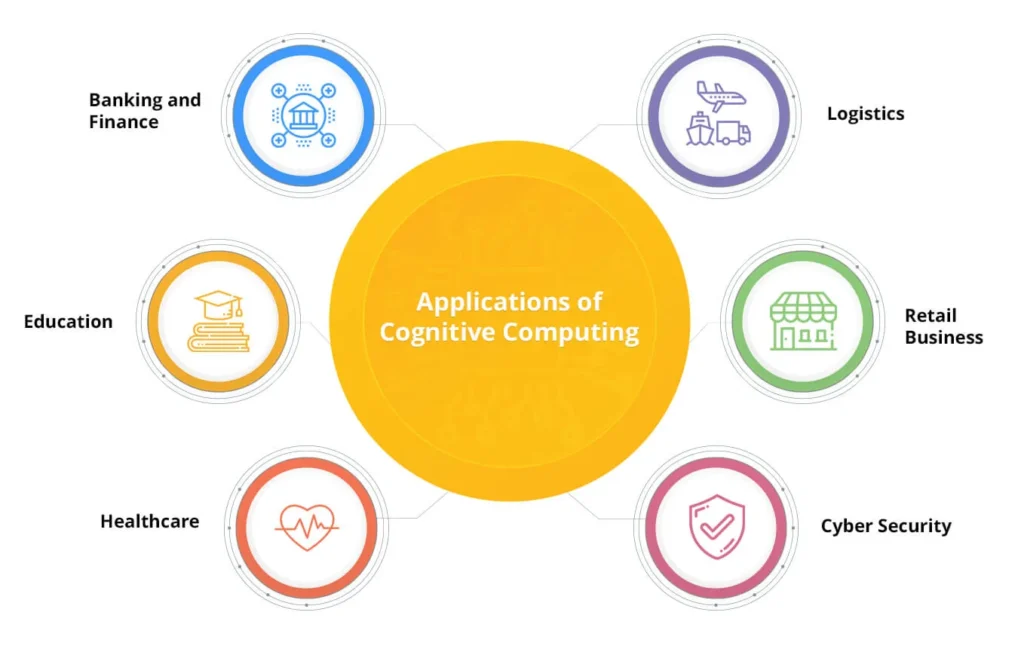
Cognitive computing has real-life applications and is used in different fields. Here is a list of them.
- Banking and Finance: Cognitive computing in the banking industry helps in improving customer engagement, operation efficiency, customer experience, and growing revenue. New analytics, deeper contextual engagement, and enterprise transformation will reshape financial and banking institutions.
- Logistics: Cognitive computing systems help in compiling storage code, automating picking with an automated guided vehicle, and using warehouse robots to improve work efficiency. It will help with inventory optimization, warehouse infrastructure management, and warehouse operations.
- Retail Business: E-commerce platforms have integrated cognitive analytics to collect basic information from customers about the products they are searching for and then analyze the available data to create a customized recommended product category list.
- Cyber Security: Cognitive computing helps prevent cyberattacks, providing a technical alternative to detect any misinformation and misleading data and making people less susceptible to manipulation.
- Healthcare: With cognitive computing systems, medical professionals can make an improved treatment decision, while improving patient outcomes. It depends on medical transcripts, real-time patient information, and other data to work on human decision-making.
- Education: The system can change the way schools and colleges operate. Cognitive computing will help provide personalized study materials to students and guide them through the coursework. It will help students understand the critical concept at their own pace.
What are the Advantages of Cognitive Computing?
The advantages of cognitive computing are aplenty. Let’s check them out.
Analytical Accuracy
One of the standout features of cognitive computing is its unparalleled analytical prowess. It excels at meticulously cross-referencing and juxtaposing both structured and unstructured data. This ensures that insights derived are not only accurate but also comprehensive, capturing the depth and breadth of the available information.
Enhanced Customer Interaction and Experience
With the explosion of data in the modern world, analyzing and deriving meaningful insights can be daunting. Cognitive computing systems streamline this process by adeptly recognizing patterns in vast data sets. This not only speeds up decision-making processes but also ensures that business strategies are informed and data-driven.
Efficiency in Business Processes
Cognitive computing helps automate repetitive and data-intensive tasks, allowing organizations to streamline workflows and reduce operational costs. By quickly analyzing large volumes of information and providing actionable recommendations, these systems enable teams to focus on strategic and creative work rather than manual data processing.
Boosting Service Quality and Employee Productivity
A less talked about but equally significant advantage is the impact of cognitive computing on workforce efficiency. By providing tools that help employees sift through and analyze both structured and unstructured data, cognitive systems empower them to discern trends and patterns more effectively. This not only improves the quality of services offered but also enhances employee productivity, as they can make informed decisions faster and with greater confidence.
Adaptability and Continuous Learning
A distinguishing feature of cognitive computing is its adaptability. Unlike traditional systems that operate based on static algorithms, cognitive computing systems evolve over time. They learn continuously from new data and interactions, refining their algorithms and improving their performance. This adaptability ensures that the systems remain relevant and efficient, even as the data landscape and user requirements change.
What are the Technologies Used in Cognitive Computing?
Cognitive computing represents the next frontier in the evolution of computational systems. At its core, cognitive computing aims to emulate the human brain’s decision-making process in machines. The cognitive computing process uses a combination of artificial intelligence, machine learning, neural networks, sentiment analysis, natural language processing, and contextual awareness to solve daily problems just like human beings.
- Artificial Intelligence (AI): At the heart of cognitive computing is AI, which enables machines to perform tasks that typically require human intelligence. These tasks include problem-solving, understanding natural language, and recognizing patterns. AI systems are designed to learn and adapt over time, becoming more efficient as they process more data.
- Machine Learning (ML): A subset of AI, machine learning enables systems to learn from data without being explicitly programmed. ML models are trained using large datasets, allowing them to make predictions or decisions without human intervention. As more data becomes available, these models can be retrained to improve accuracy.
- Neural Networks: Inspired by the human brain’s structure, neural networks are interconnected layers of algorithms that recognize underlying relationships in datasets. These networks, particularly deep neural networks with multiple layers, are essential for tasks such as image and speech recognition.
- Sentiment Analysis: This technology deciphers emotions and sentiments from textual data. For example, businesses use sentiment analysis to understand customer feedback and detect whether the sentiment is positive, negative, or neutral. This can help in tailoring marketing strategies or improving products based on feedback.
- Natural Language Processing (NLP): NLP enables machines to understand, interpret, and produce human language. It powers technologies such as chatbots, voice assistants, and translation services. NLP can extract meaning from unstructured textual data, making it valuable for tasks like information retrieval and sentiment analysis.
- Contextual Awareness: This technology understands the context in which information is presented, allowing systems to make more informed decisions. For instance, a context-aware system might adjust its response based on the user’s location, time of day, or previous interactions. By considering the context, cognitive computing systems can provide more relevant and personalized experiences.
How is Cognitive Computing Used?
Cognitive computing uses technology, such as machine learning and signal processing to expedite human interactions. You might have already spoken to a customer support bot or given commands to personal digital assistants like Alexa or Siri. Sure, they are helpful but they are pre-programmed. Thus, their interactions are limited. The bots or personalized digital assistants don’t have the ability to read or give complex responses. But in the near future, we will be able to talk to these assistants and receive a thoughtful response.
But the field of cognitive computing is evolving at a rapid pace as new applications are being introduced in education, business, and healthcare fields.
Challenges and Ethical Concerns
Challenges
Like every new technology, cognitive computing is facing some issues, even if it has the potential to change lives. A few challenges encountered by cognitive computing systems are:
Security
Since digital devices are handling crucial information, it automatically raises the question of security. Cognitive computing handles a large amount of data, and it is challenging to maintain data security with proper encryption technology. As more and more connected devices are being introduced, cognitive computing has to consider the problems related to security breaches by coming up with a foolproof security plan.
Adoption
Any new technology faces a problem with adoption. To ensure the success of cognitive computing, experts have come up with a long-term plan. The adoption process can be streamlined by collaborating with various stakeholders, such as organizations, technology developers, the government, and individuals.
Meticulous Training Process
The cognitive system requires data training for the users to completely understand the process. Its slow training process is one of the reasons behind its slow adoption. Every employee dealing with this system in an organization has to review it. The expensive and complex process of using a cognitive system makes things worse.
Lengthy Development Cycles
One of the primary challenges is the time required to develop scenario-based applications through cognitive computing. Currently, it is being developed as a generalized solution. It implies that the solution can’t be implemented across multiple segments of the industry without the right development teams and a significant amount of time to come up with a solution. Lengthy development cycles make it difficult for smaller companies to come up with cognitive systems of their own.
Change Management
Another crucial challenge cognitive computing has to overcome is change management. Usually, people are resistant to change due to their natural human behavior, and cognitive computing has the ability to learn like humans. So, it leads to the fear that machines are soon going to replace humans. It is a great example of human-machine interaction, which people need to accept.
Ethical Concerns
With cognitive computing systems being extensively used, the problem of data privacy is more likely to increase. To analyze patterns, cognitive systems study a large amount of data. This data can include personal details about individuals. Without proper protective measures, user data can be used for nefarious activities.
Another pressing issue of cognitive computing is the training of bias into systems involving predictive analysis. These systems depend on artificial intelligence techniques that learn from data that can sometimes contain bias. For example, if there is an algorithm for hiring that has been programmed to present strong candidates on the basis of historical data since the previous candidates might have been chosen through human biases, the algorithm can favor some over others. This can lead to gender or racial bias.
While human patience and attention are limited, the emotional energy of a computing system isn’t. Its limitations can be technical. Even though this can prove to be advantageous for fields, such as customer services, limitless capacity can lead to human addiction to automated tasks. With the help of these ideas, many apps are using algorithms for nurturing addictive behavior. Cognitive computing can also lead to unemployment. As the systems improve and advance to perform more critical tasks, they can start to replace workers from various fields. It will lead to economic dislocation and large-scale unemployment. Also, it can create an imbalance between people having access to these technologies and those that don’t.
What is the Future of Cognitive Computing?
Cognitive computing is expected to play a growing role in decision support systems across industries. As data volumes increase and technologies continue to evolve, cognitive systems will become more accurate, accessible, and integrated into everyday workflows.
Future developments may include more advanced digital assistants, improved human-machine collaboration, and wider adoption across sectors such as healthcare, finance, education, and public services.
FAQs on Cognitive Computing
Cognitive Computing is a subset of Artificial Intelligence that aims to simulate human thought processes in machines. It involves creating computer systems that can think, learn, and make decisions similarly to humans, often by processing vast amounts of unstructured data and understanding context.
While traditional Artificial Intelligence is designed to execute specific tasks based on pre-defined algorithms or learned patterns, Cognitive Computing endeavors to emulate human cognitive processes. This means Cognitive Computing systems can understand, reason, and learn from their environment and interactions, offering more nuanced, human-like responses.
Cognitive Computing has diverse applications across multiple industries. Some notable examples include healthcare (assisting doctors in diagnosis and treatment recommendations), finance (for fraud detection and personalized customer interactions), retail (offering personalized shopping experiences), and education (providing adaptive learning systems for students).
While Cognitive Computing systems are designed to operate with a high degree of independence, they are often used in collaboration with humans, enhancing human decision-making rather than replacing it. They act as advanced tools or assistants, providing insights and recommendations based on their learning.
Some challenges include data security concerns, the complexity and cost associated with implementing and training these systems, resistance to change from traditional methodologies, and ensuring that the technology remains unbiased and ethically sound in its decisions and recommendations.