
AI Glossary
What is Computer Vision?
Computer vision is the field of AI that trains machines to interpret and extract meaning from images, video, and visual data, enabling tasks like object detection, image classification, and scene understanding.
Computer vision uses techniques from machine learning and deep learning to identify objects, recognize patterns, and make sense of visual information. This allows computers to perform tasks like detecting faces, recognizing objects, analyzing medical scans, or helping self-driving cars navigate their surroundings.
Computer Vision in the World of AI
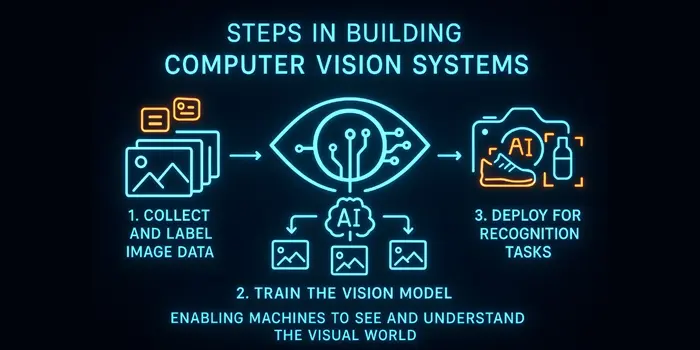
Computer vision has become essential in today’s world. It focuses on helping computers understand and work with visual data like images and videos. Instead of trying to fully copy how human vision works, computer vision systems are designed to handle specific tasks such as spotting objects, recognizing patterns, or making sense of what’s happening in a scene using deep learning and neural networks. In some of these tasks, like image classification or object detection, they can even match or outperform human accuracy.
As the amount of visual data continues to grow and computing power improves, computer vision systems have become faster and more reliable and are used across many industries. For instance, they are widely used in healthcare industry, self-driving cars, retail, manufacturing, and security, where it helps automate tasks and make quicker, more informed decisions.
How Does Computer Vision Work?
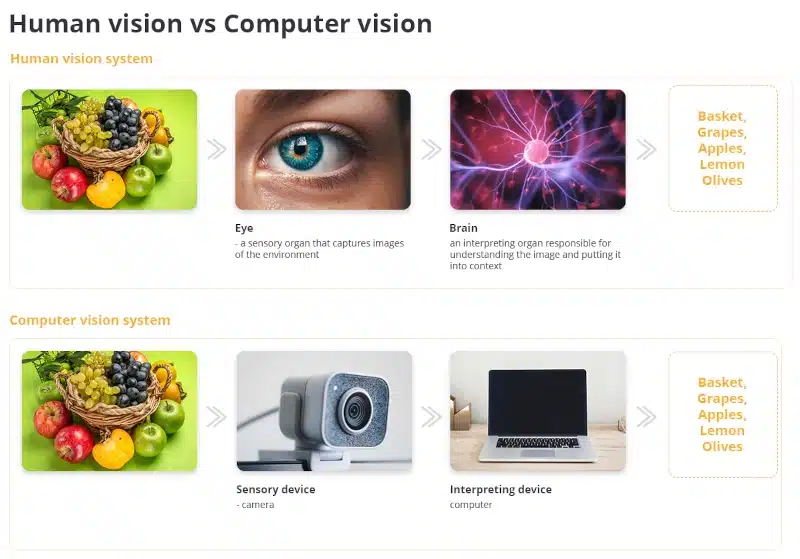
Computer vision technology helps machines understand and interpret visual information from the world. It uses models, especially deep learning systems, to learn patterns from images and videos and figure out what they represent.
Here is a step by step breakdown of how it works:
- Collecting visual data: The process starts with images or videos, captured from sources like cameras, smartphones, or drones.
- Training on labeled data: To learn effectively, models are trained on large datasets of labeled images (for example, images tagged as “car,” “dog,” or “building”). This helps the system understand what different objects look like.
- Using CNNs for learning: A common type of model used in computer vision is a Convolutional Neural Network (CNN). CNNs are especially effective at processing images because they learn patterns hierarchically, starting with edges and simple shapes and progressing to more complex features.
- Feature extraction: Instead of manually defining features, modern models like CNNs learn to extract important features on their own, starting from simple patterns (like edges) and building up to more complex ones (like objects). In practice, methods like active learning are often used alongside these models to focus training on the most informative examples, improving efficiency and reducing the need for large amounts of labeled data.
- Making predictions: Once trained, the model can analyze new images and identify objects, classify scenes, or detect patterns based on what it has learned.
- Interpreting results: Finally, the system uses these predictions to make decisions or take action, such as tagging photos, detecting defects in manufacturing, or helping autonomous vehicles navigate.
Tip:
To train effective computer vision systems, you’ll need large volumes of high‑quality image and video data – annotated, balanced, and tailored to your domain. LXT delivers custom object detection datasets, image segmentation datasets, and image classification datasets, tailored to your domain and deployment context.
Core Tasks in Computer Vision
AI computer vision systems are widely used across industries to help machines understand and interpret visual information from images and videos. It powers a variety of real-world applications that improve automation, accuracy, and decision-making.
1. Object Detection
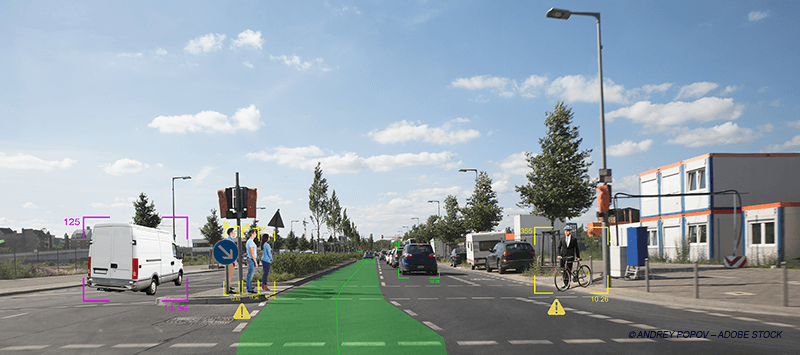
Object detection identifies and locates objects within an image or video. It not only determines what objects are present but also highlights their position using bounding boxes. This is used in areas like autonomous driving, surveillance, and retail systems.
2. Image Segmentation
Image segmentation divides an image into meaningful regions so that each pixel is assigned a label. This allows for a more detailed understanding of the scene compared to object detection. It is especially useful in medical imaging, self-driving cars, and environmental analysis.
3. Image Classification
Image classification assigns a single label to an entire image based on its main content. For example, an image may be classified as a “cat,” “dog,” or “car.” It is one of the most basic and widely used tasks in computer vision.
4. Facial Recognition
Facial recognition identifies or verifies a person by analyzing unique facial features. It compares facial patterns in images or video with stored data to confirm identity. This technology is commonly used in smartphones, security systems, and authentication processes.
5. Pose Estimation
Pose estimation detects the position and movement of a human body by identifying key points such as joints and limbs. It helps in understanding posture and motion in real time. It is used in fitness tracking, sports analysis, animation, and gaming.
Real-World Applications of Computer Vision
Computer vision is widely used across industries to automate processes, improve accuracy, and support faster decision-making. With advancements in deep learning and cloud computing, computer vision has become a core technology in many real-world applications.
1. Retail and E-Commerce Computer Vision Applications
In retail and e-commerce, computer vision technology is used for inventory tracking, shelf monitoring, cashier-less shopping, and customer behavior analysis. It helps businesses improve stock management, reduce losses, and enhance customer experience. A well-known example is Amazon Go, where you can walk into a store, pick up what you need, and leave without standing in a checkout line. Computer vision tracks what you take and handles the billing automatically.
2. Manufacturing and Industrial Automation
Computer vision is commonly used in manufacturing for quality control, defect detection, and production line automation. It helps identify faulty products, monitor assembly processes, and improve operational efficiency. This leads to faster production and more consistent product quality in large-scale manufacturing environments.
3. Automotive Industry (ADAS and Self-Driving Cars)
In the automotive industry, computer vision is essential for Advanced Driver Assistance Systems (ADAS) and autonomous driving. It enables vehicles to detect lanes, traffic signs, pedestrians, and obstacles in real time. Companies like Tesla use computer vision as a core part of their self-driving systems.
4. Healthcare (Medical Imaging)
Computer vision plays a key role in healthcare for analyzing medical images such as X-rays, CT scans, and MRIs. It helps in detecting diseases like tumors, fractures, and infections with higher speed and accuracy. This technology supports doctors in making faster and more informed diagnostic decisions.
5. Security and Surveillance
In security systems, computer vision is used for facial recognition, motion detection, and real-time monitoring. It helps improve public safety, access control, and surveillance operations. For example, facial recognition is commonly used in smartphones and secure facility access systems.
6. Transportation and Traffic Systems
Computer vision plays an important role in transportation by enabling traffic monitoring, congestion analysis, and road safety systems. It is also used in smart traffic cameras to detect violations and improve traffic flow in cities.
7. Construction and Infrastructure
In construction, computer vision is used for site monitoring, safety inspection, and progress tracking. It helps detect structural issues, monitor project development, and improve worker safety using drones and camera-based analysis.
8. Gaming and Entertainment
Computer vision is used in gaming and entertainment for motion tracking, gesture recognition, augmented reality (AR), and virtual reality (VR). It enhances immersive experiences and allows users to interact with digital environments more naturally.

What Are the Challenges of Computer Vision?
Despite all the progress, computer vision still comes with a few challenges. One of the biggest difficulties is the sheer complexity of the real world. Images can vary widely depending on lighting, angles, background clutter, and occlusion (when objects are partially hidden), which makes it harder for models to interpret them correctly.
Another challenge is data. Computer vision systems rely heavily on large amounts of high-quality, labeled images, and collecting and annotating this data can be time-consuming and expensive. Models can also struggle when they encounter situations that are very different from what they were trained on.
There are also concerns around bias and fairness. If the training data isn’t diverse enough, the system may perform poorly for certain groups or environments. Finally, computer vision models can be computationally intensive, requiring significant processing power, especially for real-time applications.
Top Computer Vision Tools and Services
To build effective computer vision systems, developers rely on specialized tools, frameworks, and cloud-based services.
Here are some of the most widely used computer vision tools and platforms:
- LXT®: LXT provides high-quality labeled datasets used for training computer vision models. It focuses on data collection, annotation, and dataset creation for use cases like object detection, segmentation, and classification.
- OpenCV: OpenCV remains one of the most popular open-source computer vision libraries. It provides a wide range of algorithms for image processing, object detection, and real-time video analysis. It is widely used in research, robotics, and production-level applications.
- TensorFlow: TensorFlow is a widely used machine learning framework used to build and train deep learning models for computer vision. It is commonly used for image classification, object detection, and segmentation tasks through pre-trained models and custom neural networks.
- PyTorch: PyTorch has become one of the most preferred frameworks for computer vision research and production. It is widely used for building deep learning models such as CNNs and vision transformers, especially in academic research and AI development teams.
- Google Cloud Vision AI: Google Cloud Vision AI is a cloud-based service that provides powerful pre-trained models for image labeling, object detection, text extraction (OCR), and face detection. It is widely used in enterprise applications for scalable image analysis.
- Amazon Rekognition: Amazon Rekognition is AWS’s computer vision service that enables facial analysis, object detection, and video content analysis. It is commonly used in security systems, media tagging, and identity verification applications.
- MATLAB Computer Vision Toolbox: MATLAB provides a dedicated Computer Vision Toolbox used for developing and testing vision algorithms. It is widely used in engineering, robotics, and academic environments for prototyping and simulation.
- NVIDIA Deep Learning SDK: NVIDIA’s computer vision stack is widely used for real-time video analytics and edge AI applications. DeepStream, in particular, is used for processing multiple video streams simultaneously in applications like surveillance and autonomous systems.
Trends and Future of Computer Vision
Computer vision continues to evolve rapidly, driven by advances in deep learning, large-scale datasets, and improved computing power. In the coming years, it is expected to become even more accurate, efficient, and widely integrated into everyday technology.
One major trend is the rise of more advanced AI models, such as vision transformers and multimodal systems that combine images, text, and audio for better understanding of real-world context. This is making computer vision more flexible and powerful than traditional approaches.
Another important development is the growth of real-time and edge-based computer vision. Instead of relying only on cloud processing, many systems now run directly on devices like smartphones, cameras, and vehicles, enabling faster and more private decision-making.
Computer vision is also expected to play a bigger role in healthcare, especially in medical imaging and early disease detection, as well as in autonomous systems like self-driving cars and smart robotics. In retail, security, and manufacturing, it will continue to improve automation and operational efficiency.
Conclusion
Computer vision is already a major part of modern AI and is becoming increasingly integrated into everyday life. As the technology advances, its focus is shifting from simple recognition tasks to more intelligent, context-aware systems. Continued research and responsible development will be key to ensuring that computer vision is used effectively and ethically in the future.
Related Concepts
Here are a few closely related topics that are often discussed alongside computer vision:
Machine Learning: A core area of AI that enables systems to learn patterns from data and make predictions. In computer vision, it is used to train models for tasks like image classification, object detection, and pattern recognition.
Deep Learning: A subset of machine learning that uses multi-layered neural networks. It powers most modern computer vision systems, especially for complex tasks like segmentation and facial recognition.
Natural Language Processing (NLP): A branch of AI that deals with understanding and generating human language. When combined with computer vision, it enables systems to interpret both images and text, such as in image captioning.
Robotics: Robotics uses computer vision to help machines perceive and interact with their surroundings. This is essential for navigation, object handling, and real-world automation.
FAQs on Computer Vision
Machine learning is a branch of artificial intelligence that enables systems to learn patterns from data and make decisions or predictions without being explicitly programmed. In computer vision, it is used to help models analyze images and videos to detect objects, recognize patterns, classify images, and understand visual scenes.
Computer vision uses a variety of algorithms, ranging from traditional image processing techniques to modern deep learning models. Most systems rely on neural network-based algorithms such as convolutional neural networks (CNNs) and vision transformers, which automatically learn patterns from large datasets to perform tasks like object detection, image classification, and segmentation.
Computer vision uses different types of data, mainly images and videos. Images are used for tasks like classification and object detection, while videos provide continuous frames for tracking and motion analysis. In more advanced applications, depth data or 3D information is also used to understand distance and spatial structure, especially in robotics and autonomous systems.
Computer vision helps businesses automate visual tasks, improve operational efficiency, and reduce human error. It enables faster and more accurate decision-making by analyzing images and videos at scale. It also improves customer experience, supports real-time monitoring, and allows companies to develop new products, services, and business models based on visual data.
It raises important privacy concerns because it can be used to analyze and track people in images and videos, sometimes without their awareness or clear consent. This includes applications like facial recognition and real-time surveillance, which can make it easier to identify and monitor individuals in public or private spaces. While these technologies can support safety and security, such as finding missing persons or preventing crime, they also create risks related to data misuse, unauthorized tracking, and over-surveillance. As a result, their use is often guided by strict privacy laws and ethical considerations in many regions and industries.
Computer vision has evolved from rule-based image processing techniques to modern deep learning systems that learn directly from large datasets. Earlier approaches relied on manually designed features for tasks like edge detection and object recognition. With the rise of deep learning, especially convolutional neural networks (CNNs), performance improved significantly in areas such as image classification, object detection, and segmentation. More recently, advances like vision transformers and large-scale AI models have further improved accuracy and enabled real-time, large-scale applications in fields such as healthcare, autonomous driving, and security.
Computer vision processing refers to the set of techniques used to help computers analyze and understand visual data such as images and videos. Instead of just displaying or storing images, it involves interpreting visual content to extract meaningful information, such as detecting objects, recognizing patterns, or understanding scenes. Modern computer vision processing is powered by machine learning and deep learning models that can automatically learn features from data and perform complex tasks like classification, detection, and segmentation.