

When a large language model confidently states that the Eiffel Tower is in London or invents a legal precedent that doesn’t exist, we call this a hallucination. But here is the uncomfortable truth: detecting hallucinations is harder than generating them. While model builders focus on scaling parameters and context windows, the real bottleneck in production AI systems is not model size. It is the data infrastructure needed to verify what these models actually say.
For enterprises deploying generative AI, the question is not whether hallucinations will occur. It is whether you have the grounding datasets, annotation frameworks, and detection benchmarks to catch them before they reach your customers. This article maps the landscape of hallucination detection datasets and explains why fact-checked AI depends on data design, not just model choice.
Building fact-checked AI systems? Get expert-annotated data at scale.
LXT provides human-in-the-loop data annotation and collection for AI training and evaluation, including domain-expert review and multilingual coverage for high-stakes use cases.
What is hallucination, really?
Hallucinations in LLMs fall into two distinct categories that require different detection strategies. Factuality hallucinations occur when a model generates content that contradicts verifiable real-world facts, such as claiming a historical event happened on the wrong date or attributing a quote to the wrong person. Faithfulness hallucinations happen when the model output diverges from provided context, such as when a summarization model introduces information not present in the source document.
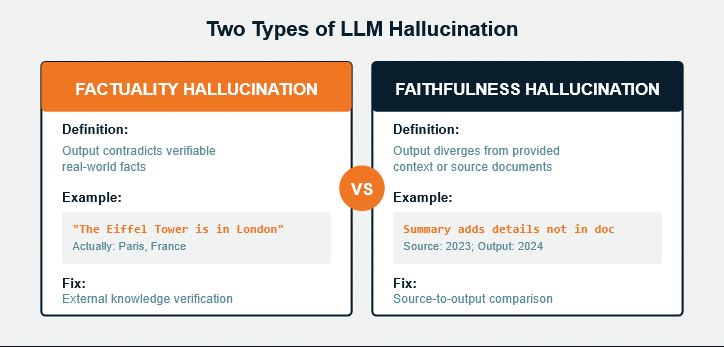
The distinction matters because detection methods differ. A 2024 survey on hallucination detection and mitigation datasets shows that factuality errors require external knowledge verification, while faithfulness errors can be caught by comparing outputs against source documents. Yet most production systems conflate these types, leading to detection pipelines that catch one while missing the other.
Why do models hallucinate? The root cause lies in how LLMs model language versus knowledge. As we explored in our analysis of language, linguistics and LLMs, these systems excel at predicting plausible-sounding text patterns but lack grounded understanding of factual truth. A model does not “know” that Paris is in France. It calculates that “Paris” and “France” statistically co-occur with high probability. When that statistical pattern breaks, or when the training data contains contradictions, hallucinations emerge.
Four detection methods that actually work
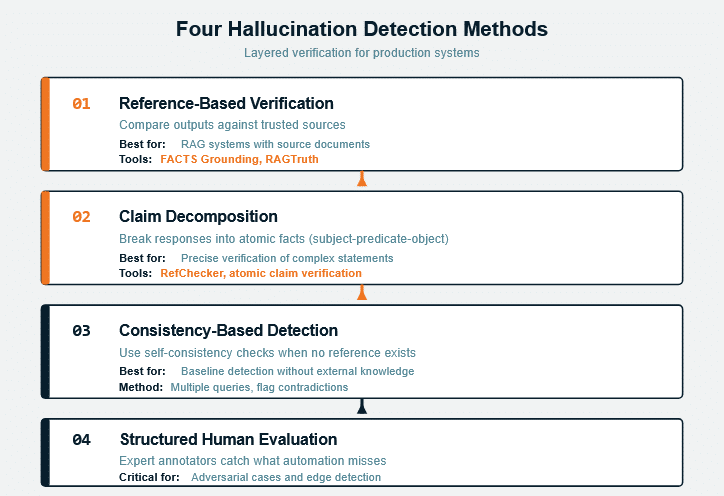
Effective hallucination detection requires layered verification. Here are four approaches that production systems use, each with distinct dataset requirements:
1. Reference-Based Verification
The gold standard for hallucination detection compares model outputs against trusted sources. This works well for RAG (Retrieval-Augmented Generation) systems where source documents are available. The FACTS Grounding benchmark from Google DeepMind exemplifies this approach, containing 1,719 examples built around a document, system instruction, and user request. Each example tests whether the model’s response stays faithful to the provided source.
However, reference-based methods require high-quality grounding corpora. The RAGTruth hallucination corpus contains nearly 18,000 naturally generated responses with case- and word-level human annotations, specifically designed for RAG hallucination detection. Unlike synthetic benchmarks, RAGTruth captures how models actually behave in production-like retrieval scenarios.
2. Claim Decomposition and Evidence Retrieval
Breaking responses into atomic facts enables precise verification. The RefChecker framework and benchmark from Amazon Science represents facts as subject-predicate-object triplets and evaluates verification across zero-context, noisy-context, and accurate-context settings. This atomic approach catches subtle hallucinations that sentence-level checks miss.
Why this matters: When a model states that “Dr. Smith conducted a 2023 study at Harvard showing 95% efficacy,” claim decomposition separates this into three verifiable assertions: (1) Dr. Smith exists, (2) a 2023 study occurred, (3) the 95% figure is accurate. Each requires different evidence sources.
3. Consistency-Based Detection
When no trusted reference exists, models can check themselves. Reference-free hallucination detection methods use self-consistency, asking the same question multiple times and flagging contradictory responses. While less reliable than evidence-based verification, these techniques provide a baseline when external knowledge is unavailable.
4. Structured Human Evaluation
Automated metrics fail to capture contextual nuances that human reviewers catch. Google’s research on adversarial testing for generative AI confirms that human evaluation remains essential for cases where automated systems show false confidence. The challenge is designing annotation rubrics that capture subtle hallucinations without overwhelming reviewers.
The dataset landscape: A production guide
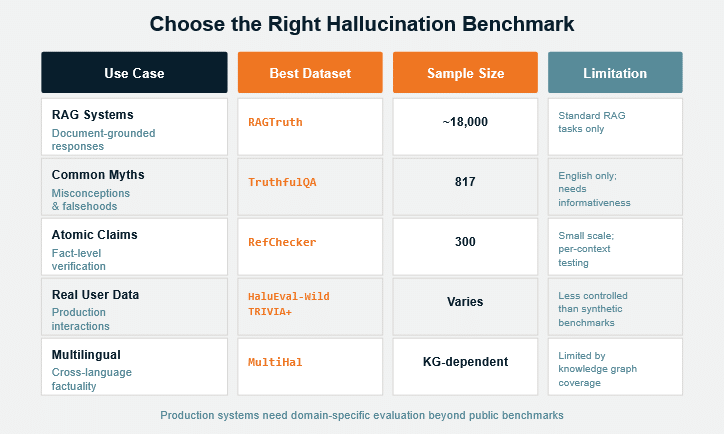
Choosing the right benchmark depends on your use case. Here is how major datasets compare:
| Dataset | Best Suited To | Annotation Design | Key Limitation |
|---|---|---|---|
| FACTS Grounding | Long-form document-grounded responses | Source document + groundedness judging; 1,719 examples | Measures faithfulness to supplied context, not open-world truth |
| RAGTruth | RAG hallucination detection | Nearly 18,000 naturally generated responses with case- and word-level human annotations | Focused on standard RAG tasks and selected model outputs |
| TruthfulQA | Common misconceptions and imitative falsehoods | 817 questions across 38 categories with true/false references | Small and primarily English; truthfulness must be paired with informativeness |
| HaluEval | Broad hallucination recognition | 35,000 generated and human-annotated samples across QA, dialogue, and summarization | Many examples are synthetically generated |
| HaluEval-Wild | Real-user interactions | Adversarially filtered prompts from real conversations | Less controlled than task-specific benchmarks |
| FACTCHD | Complex fact conflicts | Evidence chains across multi-hop, comparison, and set-operation patterns (6,960 samples) | Designed specifically for fact-conflicting hallucinations |
| MultiHal | Multilingual, multihop grounding | Knowledge-graph paths across languages | KG coverage constrains what can be verified |
| TRIVIA+ | RAG detection with organic errors | Human-verified natural hallucinations and long-context samples (3,224 instances) | Newer benchmark with shorter adoption history |
| RefChecker | Atomic claim verification | Subject-predicate-object triplets across zero, noisy, and accurate context | Small benchmark: 100 examples per context setting |
Critical insight: As we noted in our analysis of LLM benchmarks, generic benchmarks rarely predict production reliability. Public datasets provide useful baselines, but enterprise systems need domain-specific evaluation that captures their unique knowledge boundaries and user interaction patterns.
Building custom grounding datasets: The LXT approach
Public benchmarks are starting points, not endpoints. Production-grade hallucination detection requires custom datasets with specific characteristics that off-the-shelf benchmarks rarely provide:
Essential Schema Components
A production-ready hallucination dataset should include:
- User query with full conversation context
- Generated response from your specific model
- Atomic claim spans breaking responses into verifiable units
- Evidence passages from your knowledge base
- Verification labels: supported / unsupported / contradicted
- Confidence scores from both model and annotator
- Domain and language metadata
- Annotator rationale explaining judgment reasoning
- Adjudication status for disputed cases
- Severity ratings distinguishing cosmetic errors from critical misinformation
Why organic outputs beat synthetic errors
A 2024 ACL research paper on organic, human-verified hallucination labels demonstrates that synthetic hallucination benchmarks fail to capture the subtle, contextual errors that occur in real deployments. The TRIVIA+ dataset, with 3,224 annotated instances of naturally occurring hallucinations, shows that real model errors differ significantly from artificially constructed ones.
The annotation challenge: Research on organic hallucination detection reveals that automated detection plus human review identifies substantially more hallucinations than automated systems alone. RAGTruth++ analysis found that human reviewers caught errors that automated span detection missed entirely.
The multilingual imperative
Translating an English benchmark does not test culturally grounded factuality. The MultiHal benchmark demonstrates that hallucination patterns differ across languages, not just in translation accuracy, but in how knowledge is structured and verified in different cultural contexts.
Linguistic expertise in LLM evaluation becomes critical here. Factuality in Mandarin requires different evidence structures than factuality in Arabic or Spanish. Our analysis of how LLMs model language shows that capabilities vary significantly across linguistic families, meaning detection systems must be language-aware, not just language-capable.
From detection to prevention: The data pipeline
Detecting hallucinations is reactive. Preventing them requires proactive data infrastructure:
1. Pre-training data curation
The taxonomy of fact-checking datasets for LLMs reveals that training-time data quality directly impacts hallucination rates. Sources like HaluEval, ReaLMistake, TruthfulQA, and FoolMeTwice provide templates for constructing training corpora that teach models to recognize uncertainty and avoid confabulation.
2. Retrieval-augmented generation (RAG) optimization
RAG systems hallucinate less when retrieval quality improves. RAGBench contains approximately 100,000 examples with contexts and answer annotations, providing a foundation for testing retrieval-augmented systems at scale.
Key finding: Knowledge-grounded detection improves hallucination identification, but retrieval quality is decisive. Studies evaluating FactAlign, FactBench, and FELM show that external knowledge helps detection only when that knowledge is accurate and relevant.
3. Continuous monitoring with real-user data
HaluEval-Wild demonstrates why controlled benchmarks should be supplemented with real interaction data. Adversarially filtered user queries from actual conversations reveal edge cases that synthetic benchmarks miss.
Enterprise implementation: What actually works
For enterprise generative AI deployment, hallucination detection is not a research problem. It is an operational requirement. Here is what distinguishes production systems:
Domain-specific evaluation sets
Generic benchmarks measure general capability. Production systems need evaluation against domain-specific knowledge bases. A legal AI requires different grounding datasets than a medical AI or a customer support conversational AI system.
Human-in-the-loop verification
Our AI model evaluation services provide the safety layer that automated systems cannot. We combine automated pre-screening with expert annotators who verify claim-level accuracy, particularly for high-stakes domains where false positives are costly.
Multilingual factuality infrastructure
Global deployments require multilingual and computational linguistics expertise to build language-specific annotation rubrics. What constitutes a hallucination in Japanese may differ from German due to linguistic structures like evidentiality markers or honorifics that encode source reliability.
The bottom line: Data design determines reliability
LLM hallucinations are not solvable through model scaling alone. The path to fact-checked AI runs through dataset design: claim-level annotations, source-grounded labels, domain-expert verification, multilingual coverage, and realistic production benchmarks.
Public benchmarks like TruthfulQA, HaluEval, and FACTS Grounding provide essential baselines. But production systems require custom datasets built around your specific knowledge domain, user interaction patterns, and multilingual requirements. This is where training and evaluation data for generative AI becomes the critical differentiator.
The organizations that solve hallucination will not necessarily have the largest models. They will have the most sophisticated data infrastructure for detecting, annotating, and preventing factual errors. Expert-led LLM data collection and domain-expert data annotation are not service add-ons. They are the foundation of trustworthy AI.
Your next step: Audit your current evaluation setup. Are you relying on generic benchmarks that do not reflect your production environment? Do you have claim-level annotations with evidence spans? Is your multilingual coverage genuinely testing factuality, or just translation accuracy?
The datasets you build today determine the hallucinations your users encounter tomorrow.