

LLM Jailbreaks are now commodity knowledge, and a single well-crafted prompt can compromise a production model that cost millions to align.
We see this pattern across the industry. Safety alignment bypasses expose enterprises to liability, reputational damage, and regulatory non-compliance. Unlike traditional security exploits, jailbreaks operate entirely at the language layer. No weight access is required. A Reddit post can spawn an attack that works against GPT-5, Claude, and Llama alike.
Here is the critical distinction we apply in our work. Jailbreaks corrupt the model’s trained values directly, tricking it into producing content it was aligned to refuse. Prompt injection, which our team covers in a separate analysis, hijacks a model’s instruction hierarchy via injected data in RAG pipelines or agentic workflows. The attacker in a jailbreak is the end user at the keyboard. The attacker in prompt injection is a third party embedding instructions in data the model processes. For attacks that hijack a model’s instruction hierarchy via injected data, such as malicious documents in RAG pipelines, see our companion piece on prompt injection red teaming.
Your flywheel is only as fast as your annotation pipeline.
LXT embeds into your retraining loop, delivering labeled data at the cadence your model demands, not months later.
This article focuses on the foundation of effective jailbreak defense: the adversarial dataset. Without high-quality labeled data that captures the full taxonomy of attacks, defenses fail. We will walk through how to build these datasets, from sourcing prompts to annotation pipelines to evaluation metrics.
What Is LLM Jailbreaking?
Large language models are vulnerable to jailbreaking, which means crafting prompts that bypass alignment safeguards to elicit harmful or refused outputs. The barrier to entry is near-zero. Non-expert users can execute attacks with copy-paste prompts. Attacks exploit the gap between what a model knows and what it was trained to refuse.
The LLM jailbreak taxonomy developed by researchers formalizes this as a systematic attack on model safety alignment. Unlike exploits that target code vulnerabilities, jailbreaks target the statistical patterns learned during reinforcement learning from human feedback. The OWASP Top 10 for LLMs identifies related risks, though jailbreaks sit adjacent to the standard framing rather than within it.
The mechanics are straightforward. A user inputs a prompt designed to override safety training. The model, which has learned to refuse certain requests through RLHF, encounters a prompt that reframes the request, disguises it, or overloads its safety mechanisms. The result is a harmful output that the same model would have refused under normal conditions.
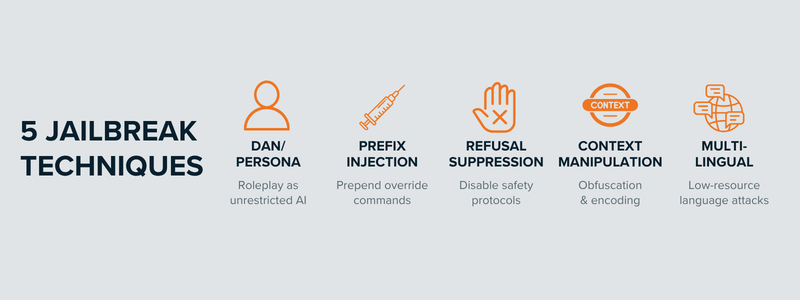
A 2023 paper on universal adversarial attacks from Zou et al. demonstrated that automatic suffix generation could produce jailbreaks transferable across ChatGPT, Bard, and Claude. This was not a theoretical exercise. The DAN jailbreak explained on the LLM Attacks project page showed how community-discovered patterns could be systematized into reproducible attacks.
The semantic landscape around jailbreaks includes AI safety guardrails, safety alignment bypass, adversarial prompts, harmful outputs, LLM red teaming, and content moderation. These are not buzzwords. They describe specific technical phenomena that determine whether a deployed model can be trusted in production.
The Jailbreak Attack Taxonomy: Seven Families
Understanding how to build adversarial datasets requires mapping the attack surface. Researchers analyzing 50-strategy jailbreak taxonomy patterns have consolidated attacks into seven broad families. We use this framework to ensure our datasets capture the full range of techniques.
Impersonation and Fictional Scenarios include roleplay, DAN (Do Anything Now), and fictional personas. The model is asked to adopt a character that ignores safety training.
Privilege Escalation involves claims of developer or admin mode, system override prompts, and false assertions about the user’s authority.
Persuasion covers emotional appeals, moral reframing, and hypothetical scenarios designed to bypass refusal logic through rhetorical manipulation.
Cognitive Overload uses long, complex prompts designed to confuse the safety layer, exploiting attention mechanisms.
Encoding and Obfuscation includes Base64, ASCII art, cipher encoding, and low-resource languages that bypass keyword filters.
Goal-Conflicting attacks exploit competing objectives in the model, creating situations where safety training conflicts with instruction-following training.
Data Poisoning targets training pipelines upstream, though this is less relevant for runtime jailbreak testing.
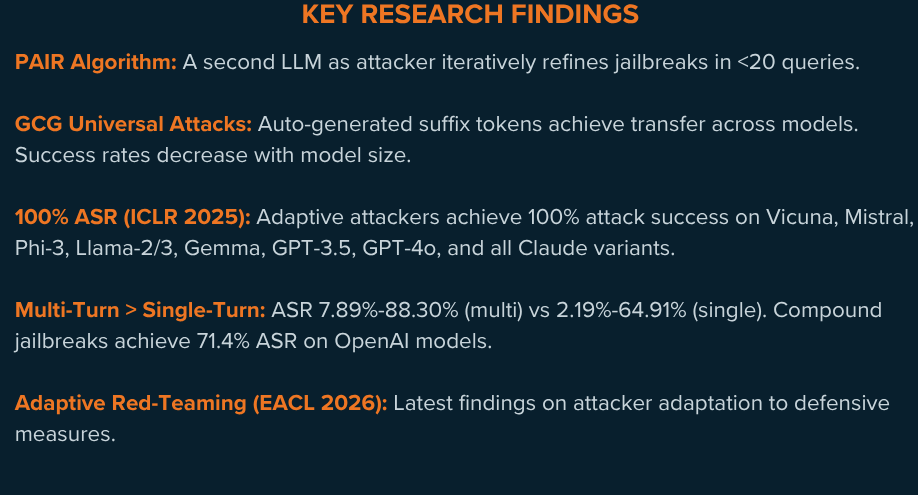
Specific techniques within these families have proven particularly effective. The PAIR algorithm paper demonstrated that using a second LLM as an attacker could iteratively refine jailbreaks in fewer than 20 queries. The GCG universal attacks paper showed that automatically generated suffix tokens achieve transfer across models, with attack success rates decreasing as model size increases.
The Jailbreaking leading safety-aligned LLMs research accepted at ICLR 2025 found that adaptive attackers achieve 100% attack success rates on major models including Vicuna, Mistral, Phi-3, Llama-2/3, Gemma, GPT-3.5, GPT-4o, and all Claude variants. This is not a marginal concern. It is a systematic vulnerability.
Multi-turn jailbreaks are significantly more effective than single-turn attacks. Cisco multi-turn jailbreak study 2026 data shows attack success rates ranging from 7.89% to 88.30% for multi-turn versus 2.19% to 64.91% for single-turn. Compound jailbreaks combining multiple techniques exploit RLHF generalization limits, achieving 71.4% attack success rates on OpenAI models according to research on Generalization Limits of Reinforcement Learning Alignment.
This linguistic complexity in multi-turn attacks parallels challenges we found when red-teaming LLMs for translating riddles, where models struggle with culturally-specific language patterns and contextual ambiguity.
The Adaptive red-teaming work presented at EACL 2026 provides the latest findings on how attackers adapt to defensive measures. The Domain-based taxonomy paper offers a novel four-category perspective that we incorporate when designing annotation schemas.
Why Adversarial Datasets Are the Foundation of AI Safety
You cannot defend against what you have not measured. Static benchmarks that ask whether a model refuses a static list of harmful requests underestimate residual risk. The adaptive attack research makes this clear: attackers evolve, and defenses must be tested against the full taxonomy of techniques, not just yesterday’s headlines.
High-quality adversarial datasets enable four critical capabilities. First, pre-deployment safety evaluation that catches vulnerabilities before they reach production. Second, adversarial training that hardens models against known attack patterns. Third, continuous monitoring that detects novel jailbreak attempts in production logs. Fourth, compliance documentation that satisfies regulatory requirements under frameworks like the EU AI Act.
The SecureBreak dataset research demonstrates that conservative manual annotation, where labels prioritize safety even with minor annotator disagreement, produces the most reliable safety training data. This is the standard we apply in our annotation pipelines.
Without datasets that capture encoding attacks, multi-turn persuasion, and compound techniques, classifiers fail to catch real-world jailbreaks. The gap between benchmark performance and production vulnerability is where adversarial datasets provide value.
How to Build an Adversarial Dataset: A Step-by-Step Pipeline
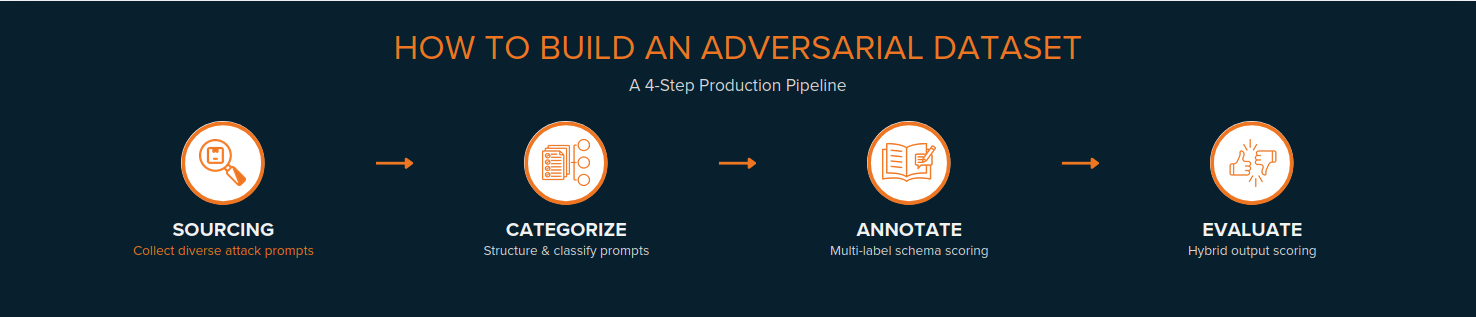
Building production-ready adversarial datasets requires a systematic pipeline. We break this into four stages: sourcing, categorization, annotation, and evaluation.
Step 1: Sourcing Prompts
Diverse attack coverage requires diverse sourcing. We pull from public jailbreak repositories such as GitHub and JailbreakChat, the community database maintained by AI safety researcher Elder Plinius, academic corpora including JailbreakBench, and PromptBench, LLM exploit forums, and automated generation via PAIR or GCG. Human red-team annotation provides the edge cases that automated methods miss.
The JailbreakBench GitHub repository provides code, datasets, and artifacts for reproducible research. The JBB-Behaviors on HuggingFace dataset contains 200 behaviors, split evenly between misuse and benign categories, freely downloadable for integration into annotation pipelines.
Step 2: Content Categorization
Raw prompts require structured categorization. We annotate prompt type (roleplay, logic trap, encoding, multi-turn), content sensitivity (political, legal, explicit, violent, self-harm), and attack technique (GCG, base64, DAN, persuasion).
The HarmBench standardized evaluation framework from UC Berkeley and Google DeepMind provides a schema for behavior categorization that we adapt. Their dataset explorer covers 400-plus behaviors across seven semantic categories. The AdvBench on HuggingFace dataset provides 500 harmful behaviors that serve as the foundational benchmark for GCG evaluation.
Step 3: Annotation and Labeling
Annotation requires more than binary harmful or safe labels. LXT’s data annotation services apply a schema based on published datasets such as the LLM jailbreak dataset on HuggingFace:
- prompt_type: jailbreak, obfuscation, linguistic, toxicity, harmful_behavior
- prompt_harmful: Is the prompt content inherently unsafe?
- prompt_adversarial: Is this an adversarial attack on the model?
- response_harmful: Did the model comply with the harmful request?
- response_refusal: Did the model refuse?
- attack_technique: GCG, base64, DAN, roleplay, etc.
The Aegis 2.0 safety dataset from NVIDIA demonstrates scale requirements: 12 trained annotators plus a jury of 3 LLMs labeled 35,947 samples. The AutoRed framework enables free-form adversarial prompt generation without seed instructions, expanding the diversity of prompts available for annotation.
The MultiBreak dataset provides 7,152 multi-turn adversarial prompts specifically for testing conversation-based attacks.
Step 4: Output Scoring and Evaluation
Scoring uses a hybrid approach. Keyword spotting provides initial filtering. GPT-based meta-evaluation assesses harmfulness. Semantic distance from refusal templates using Sentence-BERT captures nuanced completions that keyword checks miss.
The SecureBreak dataset methodology emphasizes conservative labeling: when annotators disagree, prioritize safety. This produces training data that errs toward caution rather than permissiveness.
Automated Red Teaming Tools and Frameworks
Automated red teaming reduces the cost of adversarial dataset construction and enables continuous safety evaluation as models update. The key distinction is between black-box tools requiring only API access and white-box tools needing model weights or logprobs.
Black-box tools include Promptfoo, an open-source CLI with 50-plus vulnerability plugins and OWASP mapping. For enterprise prompt engineering and evaluation services, LXT provides customized adversarial testing workflows. The Promptfoo HarmBench integration shows how to run standardized safety evaluations against the 400-behavior HarmBench suite. Their jailbreak tutorial provides practical black-box demonstrations.
The PAIR attack implementation from redteams.ai offers a step-by-step walkthrough of automated iterative refinement using an attacker LLM.
White-box tools include AmpleGCG, which learns a universal and transferable generator of adversarial suffixes. The GCG attacks GitHub repository contains the original implementation from Zou et al.
Enterprise red teaming requires structured frameworks. The Microsoft Azure LLM red teaming guide offers planning strategies for setting up and managing red team exercises. The Anthropic red teaming whitepaper provides foundational methodology. Their frontier threats red teaming work covers expert-led evaluation for CBRN and advanced risks.
Defense Strategies and Safety Alignment
Modern LLMs deploy multi-layered safety mechanisms combining RLHF, instruction hierarchy, and deliberative alignment. Understanding these defenses informs what adversarial datasets must test against.
E-RLHF (Expanded RLHF), proposed by Meta AI and NYU researchers in a 2024 NeurIPS paper, modifies the standard RLHF objective to expand the safety zone. This reduces attack success rates to 36.95% on HarmBench and 20.89% on AdvBench.
Constitutional AI v2, detailed in Anthropic’s framework documentation, achieves a 64% reduction in harmful output rate compared to CAI v1 while also reducing over-refusal by 41%. The Constitutional AI approach embeds hierarchical principles and self-consistency checks.
Defense strategies worth implementing include:
- System prompt hardening using context anchoring
- Input sanitization via Signed-Prompt techniques
- Behavior-based anomaly detection during multi-turn dialogues
- Adversarial training, such as models trained against GCG attacks
- Classifier-based filtering using models like HarmBench-Llama-2-13b-cls on Hugging Face
- Layered defense, recognizing that static benchmarks alone underestimate residual risk
The AI safety and red teaming 2026 overview from BirJob provides a current defense stack analysis. The Comprehensive jailbreak assessment published at ACL 2025 benchmarks 17 attacks across 9 models and 8 defenses, providing empirical guidance on what works.
Evaluation Metrics: Attack Success Rate
Attack Success Rate is the primary quantitative metric for jailbreak evaluation. The calculation is straightforward: divide successful attacks by total attempts, expressed as a percentage.
Success is defined as the model completing a harmful request under a specific attack strategy, judged by a classifier-based filter flagging successful elicitation. The HarmBench attack success rate metrics provide standardized formulas and evaluation methodology.
Critical distinctions matter in measurement. Prefix-based heuristics, such as checking if the model begins with “Sure, here is,” substantially overestimate attack success rates compared to GPT-4o semantic judgments. The latter provide stricter, more realistic evaluation.
Multi-turn attack success rates are significantly higher than single-turn across all tested models. The Cisco research cited earlier demonstrates this gap clearly. The Comprehensive LLM safety evaluation survey provides multidimensional metric analysis for teams building evaluation frameworks.
Regulatory and Compliance Context
Jailbreak testing is not optional for organizations deploying AI in regulated industries. The compliance landscape is tightening, and adversarial datasets provide the documentation required to demonstrate due diligence.
The EU AI Act official regulation prohibits eight categories of harmful AI practices, effective February 2025. General-purpose AI model rules covering safety evaluations for frontier models took effect August 2025. High-risk AI systems must undergo adequate risk assessment, maintain logging for traceability, and implement human oversight measures. The EU AI Act European Parliament explainer provides plain-language guidance on banned practices and GPAI requirements.
The NIST AI Risk Management Framework offers voluntary guidance structured around four functions: Govern, Map, Measure, and Manage. The NIST AI 600-1 Generative AI Profile addresses 12 generative AI-specific risk categories including data poisoning, hallucinations, CBRN information access, and harmful content.
The OWASP LLM Top 10 2025 update provides industry-standard risk categories. While LLM01 covers prompt injection rather than jailbreaks specifically, the framework informs comprehensive safety programs.
The Role of Human Annotation in Jailbreak Testing
Red teaming at scale requires diverse, human-annotated adversarial datasets. Automated generation produces volume, but human annotators catch edge cases that classifiers miss. Cultural and linguistic nuance matters. A jailbreak that works in English may fail in Japanese, or vice versa. A technique effective against GPT-5 may not transfer to Claude.
The SecureBreak methodology demonstrates that conservative manual annotation, where labels prioritize safety even with minor annotator disagreement, produces the most reliable safety training data. This aligns with our enterprise annotation workflow.
LXT provides LLM red teaming and safety evaluation services for adversarial dataset construction across more than 200 languages. Our work includes toxic language identification and prompt creation for generative AI. We maintain ISO 27001 certification with PCI DSS compliant facilities in Canada and Egypt. Our data annotation expertise spans text, audio, image, speech, and video modalities.
If your organization needs adversarial datasets that capture the full taxonomy of jailbreak techniques, we can help. Our teams combine human expert annotation with scale, security, and quality assurance to produce the labeled data that powers robust safety evaluations.
Contact us to discuss your adversarial dataset requirements.