
Egocentric Video Datasets for Robotics and Wearable AI
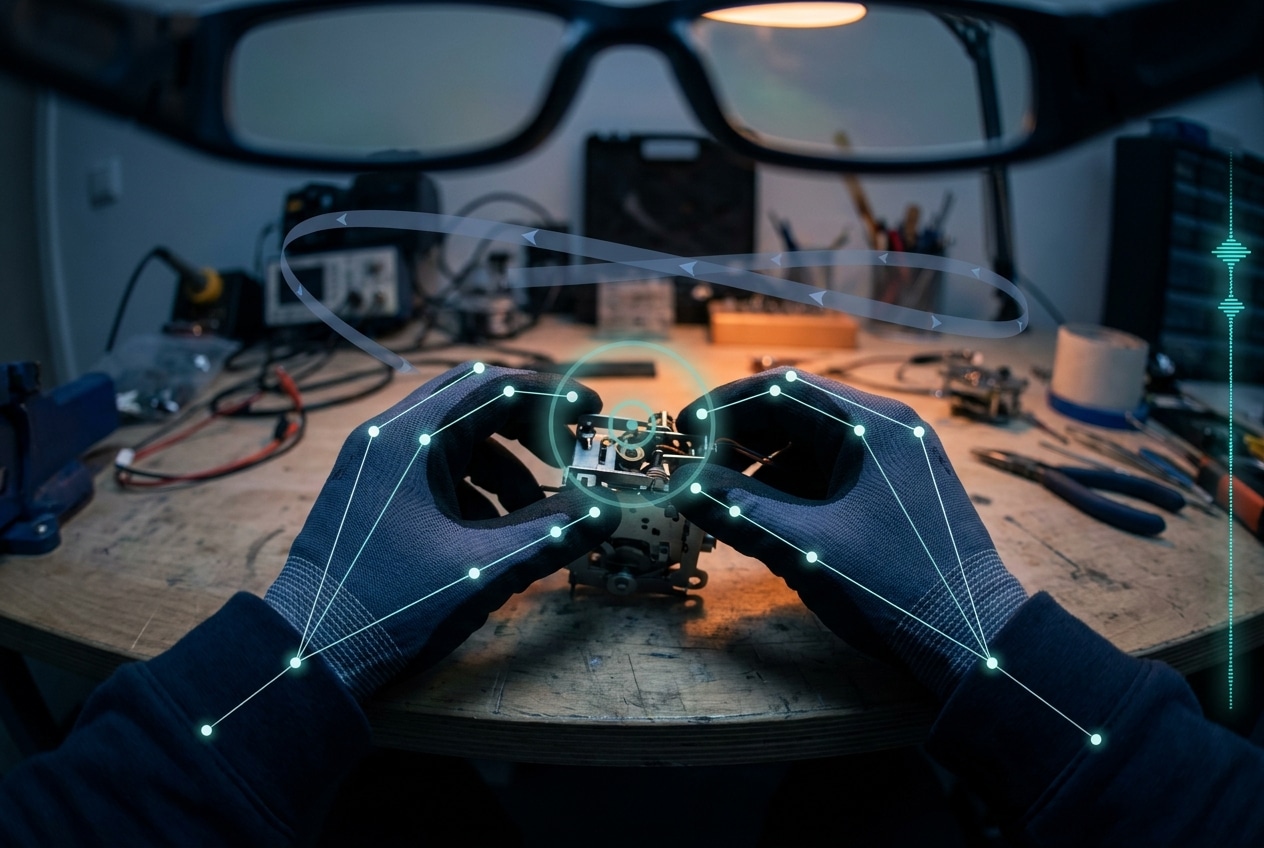
First-person video collected on your device, in your environments, with synchronized gaze, IMU and 6DoF pose. Consented participants and documented provenance, built for models that ship.
20+
Years in AI training data
1,000+
Language locales
1M+
Hours of video annotated
ISO
27001 certified
The Challenge
Public Egocentric Benchmarks Were Built for Research
Ego4D, Ego-Exo4D and EPIC-KITCHENS moved first-person video understanding forward. None of them was built to train a product.
Egocentric models are unusually sensitive to the capture rig. Field of view, lens distortion, mounting position, rolling shutter and IMU characteristics all change what the model sees, so footage from a consumer action camera does not transfer cleanly to the smart glasses or headset you actually ship.
The deeper problem is licensing and consent. Research benchmarks carry non-commercial or restricted licences, and they were never collected with the bystander consent chain an enterprise deployment requires. First-person video captures homes, faces, screens and documents, which makes provenance a legal question and not only a quality one.
Task density is the third gap. Imitation learning needs many attempts at the same task, including the ones that go wrong. Benchmarks optimise for diversity of daily life, so repeated trials and recovery behaviour are systematically thin.
LXT collects custom egocentric video on your device, in your environments, against your task taxonomy. Consented participants, documented provenance, and a synchronized sensor stack of gaze, IMU and 6DoF pose alongside the video, so what you train on matches what you deploy.
Why Teams Upgrade
Limitations of Public Egocentric Video Datasets
Standard benchmarks serve research well. Production deployments need more.
| Dataset | Primary Limitation | Impact |
|---|---|---|
| Ego4D | Research licence restricts commercial training use; captured on consumer action cameras and headsets that do not match production wearables | Licence limits |
| Ego-Exo4D | Narrow band of skilled activities such as cooking, dance and bouldering; the paired exocentric rig is not reproducible in the field | Narrow scope |
| EPIC-KITCHENS-100 | Kitchen environments only, with a small participant pool drawn from a handful of countries | Single domain |
| Charades-Ego | Scripted household actions at low resolution, with no gaze, IMU or 6DoF pose streams alongside the video | No sensor stack |
| Aria Everyday Activities | Locked to one device family and everyday scenarios rather than the task your model has to perform | Device locked |
Not sure which specs you need?
Our data specialists help you scope the right dataset for your model architecture.
Configurable Specifications
Specs Built Around Your Model
Public datasets come fixed. Yours is configured for your architecture, environment, and use case.
Capture Hardware
Device and Optics
- Devices: Smart glasses, MR headsets, action cameras, and custom head or chest rigs
- Optics: Wide-angle and fisheye fields of view matched to your production lens
- Video: 1080p to 4K at 30 or 60 fps, with rolling-shutter behaviour documented per device
Sensor Stack
Synchronized Modalities
- Gaze: Eye-tracking fixation and saccade streams where the device supports them
- Motion: IMU plus 6DoF SLAM pose, hardware-timestamped against the video
- Audio: Spatial or mono audio, with participant narration captured on a separate track
Scenario Design
Coverage and Protocol
- Regions: Multi-region participant recruitment across LATAM, EMEA, APAC and North America
- Environments: Home, retail, warehouse, industrial, clinical and outdoor settings
- Task Density: Repeated instances of the same task per participant, not one-shot daily life
Need a custom configuration?
We've built datasets across dozens of domains and use cases. Let's scope yours.
Capturing Complexity
Where First-Person Video Gets Hard
High-accuracy models handle rare attributes that public datasets miss.
Hand-Object Occlusion
In first-person view the acting hand occludes the object it manipulates for most of the interaction. Contact frames have to be annotated under partial visibility, which is exactly where public sets are weakest.
Rapid Head Motion and Blur
Head-mounted cameras produce motion blur and horizon roll that no third-person dataset contains. Models trained on stable footage degrade sharply on real wearable input.
Failure and Recovery Episodes
Robot learning needs attempts that go wrong and get corrected. Curated benchmarks keep the successful demonstrations, so recovery behaviour is missing precisely where policies need it most.
Lighting Transitions
Walking from indoors to outdoors swings exposure several stops within a second. Auto-exposure artifacts, glare and low-light noise need deliberate coverage rather than incidental capture.
Ground Truth Quality
Human-in-the-Loop Annotation
Precise annotation bridges raw data and learnable signal. Expert annotators deliver precision automated tools can't match.
Hand and Object Contact
Frame-level hand and object bounding boxes with contact state, grasp type and bimanual coordination labels, each verified by a second annotator before delivery.
Temporal Action Segmentation
Start and end boundaries for every action under a verb-noun taxonomy, with long-horizon step structure and object state-change labels before and after contact.
Dense Narration and Gaze
Timestamped natural-language narration for vision-language training, aligned to gaze fixation labels so the model learns where attention actually went.
Industry Applications
Egocentric Video Datasets for Your Domain
Custom taxonomies and collection protocols for specific deployment contexts.
Robotic Manipulation
Imitation learning from human demonstration
Smart Glasses Assistants
Contextual AI that sees what the wearer sees
AR and MR Interaction
Hand tracking and intent prediction
Industrial Work Instruction
Assembly verification and on-the-job training
Clinical Skill Assessment
Procedural technique and workflow analysis
Warehouse and Field Service
Pick, pack and repair workflow models
Accessibility
Visual assistance for low-vision users
Sports and Skill Coaching
Technique feedback from the athlete view
Compliance & Ethics
Secure and Ethical Data Collection
Data collection involving people and sensitive content requires robust security, compliance, and ethical protocols at every stage.
Global Demographic Reach
Collection across 1,000+ locales and diverse demographics to prevent algorithmic bias in your deployed models.
ISO 27001 Certified
Sensitive projects processed in certified secure facilities meeting the highest information security standards.
GDPR & Privacy Compliance
All collection and annotation protocols vetted for consent and privacy. Legally robust for global deployment.
Frequently Asked Questions
Egocentric Video Dataset FAQs
Can you collect on our specific device?+
Yes, and it is usually the right call. We collect on smart glasses, MR headsets, action cameras and custom head or chest rigs, including pre-release hardware under NDA. Matching your production optics and IMU is the single biggest driver of whether a model transfers from training to deployment.
How do you handle bystander privacy?+
Participants consent explicitly to first-person capture, and collection protocols restrict where and when recording happens. We apply face, licence plate and screen blurring on request, document the consent chain per session, and can exclude specified locations outright. This is the main reason teams cannot simply use a public benchmark commercially.
Can you match a public benchmark taxonomy?+
Yes. We routinely mirror Ego4D or EPIC-KITCHENS verb-noun taxonomies so you can pretrain on public data and fine-tune on ours, then extend the taxonomy with the classes your product needs and the public sets do not cover.
Do you deliver gaze, IMU and pose alongside the video?+
Where the device exposes them, yes. Streams are hardware-timestamped and delivered synchronized to the video, with a documented calibration and any clock drift reported. If your device lacks eye tracking we will say so rather than interpolate a gaze signal.
Can you collect outside North America and Europe?+
Yes. Multi-region collection is a core part of this offer, including LATAM and APAC. Geographic coverage matters more for egocentric data than most modalities, because homes, kitchens, streets, retail layouts and tools differ enough to shift model performance measurably.
What does a custom egocentric video dataset cost?+
Most programs range from about $60K for a focused single-task collection on one device to $400K and above for multi-region, multi-device programs with dense annotation. We provide a detailed quote after a short feasibility review of your device, task list and target regions.
How long does a collection take?+
Typical timelines are 6 to 10 weeks for a focused single-region collection and 12 to 20 weeks for multi-region programs. Participant recruitment and device logistics drive the schedule more than annotation volume does, so early clarity on hardware shortens it materially.
Is egocentric video the same as POV video?+
In practice yes. POV, point-of-view and first-person video all describe footage recorded from the wearer’s own viewpoint. Egocentric is the term the research literature uses, which is why benchmark names like Ego4D and EPIC-KITCHENS carry it. What decides whether the data trains a usable model is not the label but whether the capture rig, the sensor streams and the consent chain match what you deploy.
Get Started
Scope Your Custom Egocentric Video Dataset
Tell us the device, the task list, the regions and which sensor streams you need. A data collection specialist will come back with a feasibility assessment and a scoped quote within 48 hours.
Please provide us with the details of your inquiry and one of our team members will be in touch.
Join our global team of contributors today
Apply here to be considered for future projects including data collection, annotation and transcription
Start application