AI Glossary
Generative Adversarial Networks (GANs) – Brief Explanation
Generative adversarial networks (GANs) are deep learning models where a generator network creates synthetic samples and a discriminator network evaluates them, with both networks improving through adversarial training. First introduced by Ian Goodfellow in 2014, GANs are used for image synthesis, data augmentation, privacy-preserving synthetic data, and robustness testing in production AI pipelines.
Practical Uses of GANs in Data Pipelines
GANs are no longer discussed only as image-generation demos. In production programs, they are used for controlled augmentation, privacy-preserving synthesis, and robustness testing when paired with strict quality validation.
Synthetic data can improve coverage, but it cannot fully replace real-world labeled data. Teams still need representative human-reviewed datasets — like custom image classification datasets — to prevent model drift and unrealistic outputs.
Key implementation points
- Validate synthetic samples against real-world distribution shifts.
- Use domain-specific acceptance criteria before merging synthetic data into training sets.
- Keep human evaluation in the loop for safety-critical and brand-sensitive use cases.
Related LXT resources
GANs are widely used for tasks like image synthesis, data augmentation, and speech enhancement, and are especially valuable when high-quality, labeled training data is limited.

Table of Contents
- How do Generative Adversarial Networks work?
- Types of Generative Adversarial Networks (GANs)
- Applications of Generative Adversarial Networks (GANs)
- Advantages of Generative Adversarial Networks
- Disadvantages of Generative Adversarial Networks
- Tips for Training a Generative Adversarial Network (GAN)
- Generative Adversarial Networks and Convolutional Neural Networks
How do Generative Adversarial Networks work?
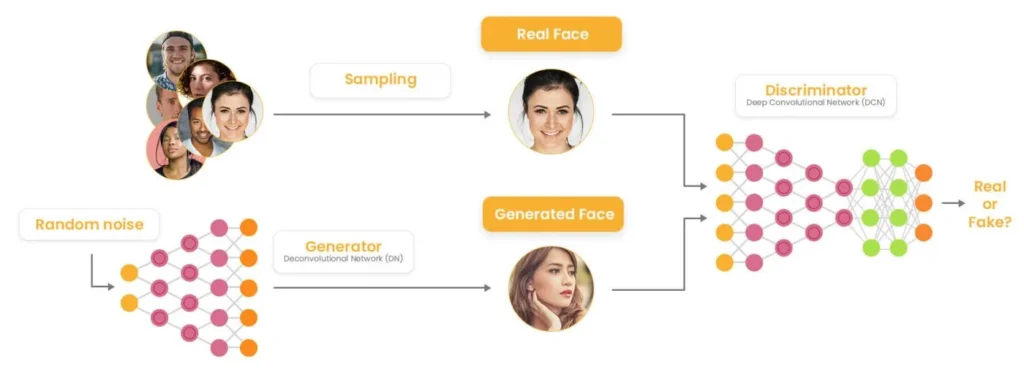
GANs work by training two neural-networks against each other, one to generate fake data and one to identify the fake data. The generator network produces fake data, and the discriminator network tries to identify which data is fake. As the networks train, the generator gets better at creating fake data that is hard to distinguish from real data, and the discriminator gets better at identifying fake data. The end result is a set of generated data that is very realistic. The successful implementation of GANs often requires large and diverse audio data collections to train the artificial intelligence models effectively.
Introduction to GAN – by Serrano.Academy
Types of Generative Adversarial Networks (GANs)
Over time, researchers have developed several GAN variations to solve specific problems and improve training stability, control, and output quality. While the core idea remains the same, each type is designed for different use cases.
Vanilla GAN
This is the original GAN architecture introduced in early research. It uses a simple generator and discriminator trained together from scratch. Vanilla GANs are mainly used for learning the fundamentals of adversarial training and basic data generation.
Deep Convolutional GAN (DCGAN)
DCGANs use convolutional neural networks instead of fully connected layers. This makes them especially effective for image generation tasks. They produce more stable training results and significantly better image quality compared to the original GAN design.
Conditional GAN (cGAN)
A conditional GAN (cGAN) is a type of generative adversarial network (GAN) in which the generator learns to generate images from a set of specified conditions. For example, a cGAN could be trained to generate images of faces that have been digitally altered to look like a specific person. The power of cGANs lies in their ability to learn complex relationships between input and output data.
This makes them well-suited for tasks such as image editing and colorization, where the input data (e.g., a black-and-white photo) may have a complex relationship with the output data (e.g., a color image). cGANs have also been used for text-to-image synthesis, 3D object reconstruction, and super-resolution.
CycleGAN
CycleGANs are designed for image-to-image translation without needing paired training data. They are commonly used to transform images from one domain to another, such as converting daytime scenes into nighttime scenes or turning sketches into paintings.
StyleGAN
StyleGAN focuses on generating very high-resolution and highly detailed images, especially human faces. It allows fine control over visual features like lighting, texture, and facial attributes, which makes it popular in creative and media applications.
Wasserstein GAN (WGAN)
WGAN improves training stability and reduces common problems such as mode collapse. It uses a different training objective that makes the learning process smoother and more reliable.
Applications of Generative Adversarial Networks (GANs)
GANs are used across a wide range of creative and practical tasks, especially when real data is limited or difficult to obtain. They can generate new images, videos, text, and synthetic datasets that support machine learning development and testing.
Common applications include:
- Generating realistic images or videos of people, objects, or scenes that do not exist
- Creating synthetic data for training machine learning models
- Producing medical images and other sensitive datasets for research while protecting privacy
- Creating 3D models from 2D images
- Improving image and video quality through enhancement and restoration
- Increasing image or video resolution (super-resolution)
- Supporting creative industries such as art, design, and media production
As research and tooling continue to evolve, new uses for GANs continue to emerge across industries.
Advantages of Generative Adversarial Networks
GANs are an invaluable tool for data augmentation, or for creating training data for machine learning models.
There are several advantages of using GANs for data generation:
- GANs can generate high-quality images that look realistic to humans.
- It can be helpful in generating diverse data samples, which is helpful for training machine learning models.
- GANs are relatively easy to train, and they often converge faster than other types of generative models.
- GANs have the potential to learn from data with little or no label information, which is helpful for unsupervised learning tasks.
Tip:
Would you also like to achieve high-quality results with the use of GANs? Get suitable training data in the form of photos, video or audio recordings entirely according to your wishes from LXT.
Disadvantages of Generative Adversarial Networks
While GANs have been praised for their ability to generate high-quality data, there are also some disadvantages to using this technology.
- One issue is that GANs can be notoriously difficult to train. This is because the two networks in a GAN (the generator and the discriminator) are constantly competing against others, which can make training unstable and slow.
- Additionally, GANs often require a large amount of training data in order to produce good results. This can be a problem if the dataset is not readily available or if it is too small.
- Finally, GANs can be vulnerable to mode collapse, which is when the generator only produces a limited number of outputs instead of the variety that is desired.
Tips for Training a Generative Adversarial Network (GAN)
When training a generative adversarial network (GAN), it is important to keep a few key considerations in mind:
- First, the generator and discriminator networks must be well-balanced in order to avoid mode collapse.
- Second, it is important to use a diverse set of training data in order to create a robust model.
- Finally, the training process must be carefully monitored in order to ensure that the model converges.
By following these tips, you can ensure that your GAN is able to achieve its full potential.
Generative Adversarial Networks and Convolutional Neural Networks
Convolutional neural networks are a type of deep learning algorithm that are particularly well suited for image classification tasks. On the other hand, GANs are a type of algorithm that is used for generating new data samples based on a training set. Recently, there has been a lot of interest in using GANs for generating realistic images, and many state-of-the-art results have been achieved.
It is often necessary to use convolutional neural networks as a part of the training process for GAN. In addition, convolutional neural networks can be used to improve the results of GANs by providing additional constraints. As a result, the combination of convolutional neural networks and generative adversarial networks is a powerful tool for image generation tasks.
Simple Architecture of a GAN