
AI Glossary
What is Image Recognition?
Image recognition is a field of computer vision in which AI models identify and classify objects, people, text, or scenes in digital images. Modern image recognition systems use deep learning architectures like convolutional neural networks (CNNs) and vision transformers (ViTs), trained on large labeled datasets to learn visual patterns and generalize to new images.
How does Image Recognition work?
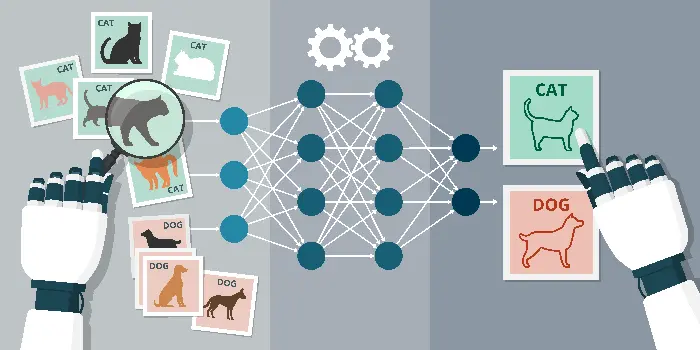
This technology works by analyzing an image and automatically learning patterns and features from it. In traditional approaches, this process involved separate steps such as feature extraction, identification, and classification. Today, modern deep learning models perform these steps together within a unified architecture, learning relevant features directly from large datasets without manual intervention. During training, models such as Convolutional Neural Networks (CNNs) learn visual features from labeled images, and during inference, they map new images to the most likely categories based on what they have learned.
These capabilities are enabled by advanced techniques in machine learning, particularly deep learning, which power modern image recognition systems.
Convolutional Neural Networks (CNNs):
Convolutional Neural Networks (CNNs) are widely used models for image recognition. They scan images and pick out things like edges, shapes, and patterns that help identify what’s in the picture. CNNs are highly effective for tasks like image classification, object detection, and facial recognition.
Vision Transformers (ViTs):
Vision Transformers are a newer type of model that use attention mechanisms to analyze images. Unlike CNNs, which focus on local features, ViTs capture global relationships within an image, making them powerful for complex recognition tasks when trained on large datasets.
Multimodal Models:
Multimodal models combine image recognition with other data types, such as text or audio. They can understand both visual and contextual information, enabling applications like image captioning, visual question answering, and AI assistants.
Tip:
To develop a reliable image recognition system, you need custom‑built image datasets that match your model’s target objects, environment and use case—off‑the‑shelf collections rarely suffice. At LXT, we provide model‑specific image data collection services, delivering high‑quality, diverse visual data exactly as your AI model needs.
Different Types of Image Recognition
Image recognition systems can be categorized based on the tasks they perform. Common types include:
Image Classification:
Assigns a label to an entire image (e.g., “dog,” “chair,” or “tree”). It is often used in applications like content filtering, medical diagnosis, and automated tagging.
Object Detection:
Identifies and locates multiple objects within an image using bounding boxes. This technique is widely applied in surveillance, autonomous vehicles, and retail analytics.
Image Segmentation:
Divides an image into regions or pixels to provide a more detailed understanding of object boundaries. It enables precise tasks such as medical image analysis and background removal.
Facial Recognition:
Identifies individuals based on facial features and is commonly used in security, authentication, attendance tracking, personalized user experiences, and law enforcement.
Text Recognition (OCR):
Extracts and converts text from images into machine-readable format. This is commonly used in document digitization, license plate recognition, and translation tools.
Scene Understanding:
Analyzes the overall context of an image, including relationships between objects and their environment. It helps systems make more informed decisions by interpreting complex real-world scenarios.
Image Captioning and Multimodal Systems:
Advanced systems that combine image recognition with language understanding to generate descriptions or answer questions about images. They are key to applications like assistive technologies, search engines, and human-computer interaction.
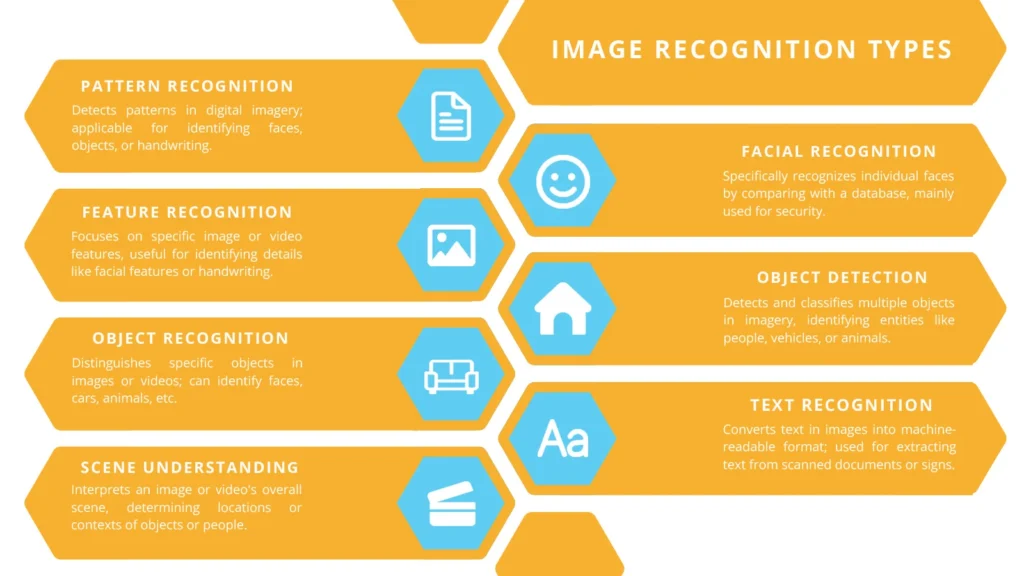
Image Recognition Applications in the Real World
These systems are used in many different applications, such as facial recognition in smartphones and computer vision for autonomous cars. The technology has different use cases, and authorities are using it in security, monitoring, and public safety applications while businesses use it to target ads at users. Some of the more common uses are:
Security Systems
In security systems, cameras equipped with image recognition software can be used to detect intruders and track their movements. Future use cases include authentication purposes such as letting employees into restricted areas as well as tracking inventory or issuing alerts when certain people enter or leave premises.
Autonomous Vehicles
Self-driving cars rely on image recognition to identify objects on the road, such as other vehicles, pedestrians, traffic lights, and road signs. By utilizing image recognition and sophisticated AI algorithms, autonomous vehicles can navigate city streets without needing a human driver.
Medical Applications
Medical images are a vital part of modern-day healthcare and can be used to diagnose diseases, detect cancerous tumors, and track the progression of a disease.
Business
Image recognition can potentially improve workflows and save time for companies across the board! For example, insurance companies can use these systems to automatically recognize information, like driver’s licenses or photos of accidents. This would save employees hours of work every day.
Law Enforcement
Security cameras can use image recognition to automatically identify faces and license plates. This information can then be used to help solve crimes or track down wanted criminals.
News and Media
The use of image recognition in news and media is increasing and it can be applied in several ways, such as identifying people and stories for advertising or content generation. The technology is also used to track user behavior on websites or through app interactions. This allows news organizations to curate their content more effectively and ensure accuracy.
E-commerce
In e-commerce, image recognition can help quickly find products on a website or in a store. It compares prices, finds better deals, and provides product reviews and recommendations.
Challenges
Like any AI system, image recognition comes with its own set of real-world limitations that affect how well it performs in practice.
Why Training Data Quality Matters:
Image recognition relies a lot on the quality and variety of the data it is trained on. Production teams often build on top of custom image classification datasets tailored to their specific domain. If the dataset is small, uneven, or not labeled properly, the system won’t perform well when it faces real-world images. Things like lighting changes, different camera angles, busy backgrounds, or low-quality images can easily affect how well it understands what it’s seeing. Rare or unusual cases are especially tricky because they often expose weak spots in the model. Even small labeling mistakes can cause bigger issues over time, leading to biased or incorrect results.
Computational and Technical Limitations:
Training modern image recognition models also takes a lot of computing power. These systems need large datasets and powerful hardware, which makes them expensive and time-consuming to build and deploy. This can be a challenge for smaller teams or real-time applications where speed and efficiency matter.
Security, Ethics, and Real-World Risks:
There are also concerns around how these systems are used and misused. AI-generated images and deepfakes are making it harder to tell what’s real and what isn’t and many models also don’t clearly explain how they make decisions, which can be a problem in sensitive areas. On top of that, small changes in an image can sometimes trick a system completely, which raises security concerns. Privacy and ethical issues are also important, especially when image recognition is used in surveillance or facial recognition systems.
The Future of Image Recognition
Image recognition has evolved from a research-focused technology into a widely deployed solution across industries such as healthcare, autonomous systems, and security. It has now become a core component of modern Artificial Intelligence systems.
Recent advancements are being driven by deep learning and the rise of multimodal AI models that can process both images and text together. These models can power things like image captioning, visual question answering, and intelligent assistants.
Looking ahead, the focus is expected to shift from improving raw accuracy to enhancing reliability, efficiency, and real-world usability. Key developments include better performance on edge devices, improved handling of noisy or ambiguous data, and stronger safeguards against bias and misuse.
As image recognition becomes part of everyday apps and devices, questions around privacy, ethics, and trust will become even more important.
Related Concepts
Here are a few closely related topics that are often discussed alongside image recognition:
Machine Learning: A branch of AI that helps systems learn patterns from data and make predictions. In image recognition, it’s used to train models that can identify objects and classify images without being explicitly programmed for every rule.
Deep Learning: A subset of machine learning that uses neural networks with many layers. It powers most modern image recognition systems and is especially useful for tasks like detecting objects, segmenting images, and recognizing faces.
Computer Vision: A wider field that focuses on helping machines understand images and videos. Image recognition sits inside computer vision as one of its main tasks, along with detection, tracking, and scene analysis.
Multimodal AI: An area of AI that combines different types of information like images, text, and audio. It helps systems understand visual content in context, such as describing images in words or answering questions about what’s in a picture.