
Data annotation outsourcing is the practice of contracting a specialist workforce to label, generate, evaluate, or red-team the data your AI models learn from. The right partner depends on five things: workforce composition, vendor neutrality, quality metrics matched to your task type, multilingual and domain coverage, and labor diligence. Costs in 2026 range from roughly $10 an hour for commodity labeling to $300 an hour for board-certified expert generation.
The market a buyer faces in 2026 looks nothing like the one most procurement frameworks were written for. Two years ago this was a labeling industry. Today, the spend is shifting toward expert generation, preference data for RLHF, model evaluation, and red-teaming. The vendor landscape consolidated under Meta’s $14.3 billion investment for a 49% non-voting stake in Scale AI in June 2025, prompting OpenAI and Google to pull work the same week. New problems showed up that weren’t on anyone’s RFP a year earlier: annotators outsourcing their labeling jobs to ChatGPT, multilingual safety gaps that pass English evals and fail in Yoruba, and lawsuits over wage theft and psychological harm that have changed what reasonable diligence looks like.
This guide gives you a 2026 framework for evaluating data annotation outsourcing partners across the dimensions that actually matter now. We assume you are evaluating a partner for serious model work, not running a one-off labeling sprint.
Your flywheel is only as fast as your annotation pipeline.
LXT embeds into your retraining loop, delivering labeled data at the cadence your model demands, not months later.
What’s actually being outsourced in 2026
The biggest mistake we see in buyer requirements documents is treating “data annotation outsourcing” as labeling. Labeling is one piece. The frontier of human-data work has expanded into five categories, and most modern programs need three or four of them.
Labeling and classification. The original task: bounding boxes on images, named-entity spans on text, intent labels on utterances, segmentation masks on medical scans. Still the largest category by volume, still the right starting point for many supervised computer vision and NLP systems.
Preference and ranking data for RLHF. The dominant paradigm for aligning instruction-tuned models since Ouyang et al.’s InstructGPT work in 2022. Their headline finding was that “outputs from the 1.3B parameter InstructGPT model are preferred to outputs from the 175B GPT-3, despite having 100x fewer parameters” once trained on human preference rankings. Anthropic’s parallel HH-RLHF release used roughly 169,000 preference comparisons to train a helpful and harmless assistant, with preference models updated “on a weekly cadence with fresh human feedback data.” Preference work is structurally different from labeling: there is no ground truth, and reasonable annotators will and should disagree on hard pairs. The metrics, the QA, and the workforce profile are all different.
Expert-written generation. Subject-matter experts writing reference answers, rubrics, multi-step reasoning chains, and edge-case scenarios. This is where the most expensive human-data spend now sits. Publicly disclosed rates for expert-tier contractors run from roughly $60 an hour for generalist experts to $130 to $300 an hour for board-certified specialists in medicine and law. These are not labeling rates. They reflect the cost of getting a physician to write a grounded answer to a clinical question, or a tax attorney to walk through a multi-jurisdiction edge case.
Adversarial and red-team work. Structured probing of model harms, jailbreak resistance, refusal calibration, and prompt-injection defenses. The methodology is closer to security research than labeling. Generic crowd workforces cannot do it. Our LLM red-teaming service uses a smaller, vetted pool with adversarial training and rotation policies for psychological load.
Evaluation and human-in-the-loop QA. Pairwise model comparisons, rubric-based scoring, factuality checks against retrieved sources, and validation of synthetic data generated by other models. Increasingly the highest-leverage human work, because one well-written eval shapes thousands of training decisions. See our AI model evaluation and training data validation services.
A 2026 program will typically need a mix. A reasonable shape for a frontier-adjacent model: 30% labeling and classification, 25% preference data, 25% expert generation, 10% red-team, 10% evaluation. Vendors comfortable in only one or two categories will leave gaps you’ll fill expensively yourselves.
The vendor consolidation problem you have to solve before anything else
In June 2025, Meta paid $14.3 billion for a 49% non-voting stake in Scale AI, valuing the company at roughly $29 billion. Alexandr Wang left to lead Meta’s new Superintelligence team. Within days, OpenAI publicly began phasing out Scale as a data provider, and Google, reportedly Scale’s largest customer with around $200 million in planned 2025 spend, signalled it was doing the same. By October 2025, Mercor had reached a $10 billion valuation and Surge AI was raising up to $1 billion at roughly $15 billion. TechCrunch reported that even inside Meta’s own TBD Labs, “researchers view Scale’s data quality unfavorably and prefer the two competitors.”
The lesson is not that Scale is bad or that Meta is the villain. The lesson is that vendor neutrality stopped being a procurement nicety and became a model-IP question. If your annotation partner has a structural relationship with a frontier lab competing with you, your data, your taxonomy, your edge cases, and your failure modes are no longer fully yours. ISO 27001 certification doesn’t address this. Contractual language does, and not all vendor MSAs have caught up.
Three questions to add to any 2026 RFP:
- Does the vendor have a single customer representing more than 25% of revenue, and if so, who?
- Does the vendor’s parent or majority investor compete with us in foundation models, applications, or AI infrastructure?
- What contractual restrictions exist on the vendor using insights from our taxonomy, evaluation rubrics, or failure cases to improve internal capabilities or other clients’ work?
Vendors that can answer all three cleanly are rarer than they should be.
What drives cost in 2026, and what it actually costs
Per-label rate cards have largely disappeared from the industry since 2022 because they don’t reflect what serious buyers are buying. We won’t publish one, and we’d be skeptical of any vendor who does without seeing your task. What we can give you is the cost spread you should expect across the major work types, with sources where they’re public.
| Work type | Typical hourly rate range |
|---|---|
| Generalist labeling, simple tasks | $10 to $25 / hr |
| Skilled labeling (linguistic, domain-trained) | $25 to $60 / hr |
| Expert generation, generalist | $60 to $200 / hr |
| Expert generation, legal specialist | $85 to $120 / hr |
| Expert generation, MD specialist | $130 to $300 / hr |
Ranges are based on publicly disclosed contractor rate cards across the industry as of 2026. The 30x spread between commodity labeling and expert MD work reflects real differences in what you’re getting. A board-certified physician annotating clinical reasoning is not 30x more productive than an MTurk worker, but the value per annotation is structurally different and the supply is structurally constrained.
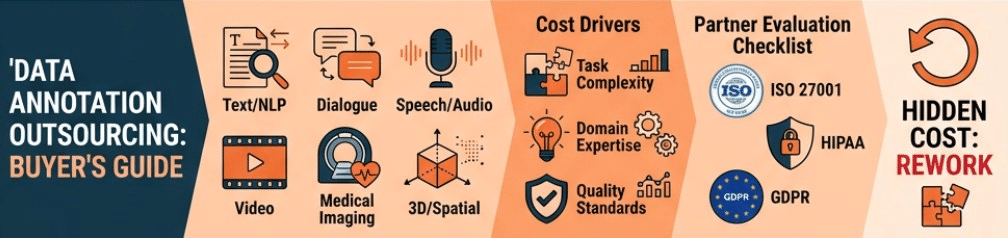
The biggest cost variables that should appear in any vendor quote:
- Task complexity and judgment load. Binary classification is cheap. Multi-step adjudication is not. Ask vendors to walk through how they estimate time on task for your specific work, not generic categories.
- Domain expertise required. A generic annotator costs less than a clinically trained one. Either the annotator brings the expertise, or your team spends it in training cycles and rework.
- Modality. Video annotation is more time-intensive than text annotation for equivalent coverage because every frame may require labels. LiDAR and 3D point-cloud work add cognitive load that shows up in price.
- Language and locale. Major languages are accessible. Low-resource languages and regional dialects need native-speaker sourcing that adds coordination overhead.
- Quality bar. Higher inter-annotator agreement targets, more QA rounds, and smaller batch sizes raise unit cost and lower rework. The math usually favors the higher quality bar.
The hidden cost most buyers underprice is rework. A vendor with 95% first-pass accuracy and 30% rework is more expensive than one with 90% first-pass accuracy and 5% rework. Ask explicitly about defect rates, who absorbs rework cost, and what the contractual remedy is when output falls below threshold.
Quality metrics: stop applying labeling thresholds to preference data
Most buyer’s guides quote the Artstein and Poesio (2008) recommendation that inter-annotator agreement (IAA) above 0.8 indicates reliable annotation. That threshold is a sensible floor for objective span and classification work. It is the wrong metric for preference data, where reasonable annotators should disagree on hard pairs by design.
Use task-appropriate quality metrics:
For classification and span labeling. Cohen’s kappa or Krippendorff’s alpha, with 0.8 as a working floor on objective tasks, 0.67 acceptable on more subjective categorical work. F1 against a held-out gold set is the cleaner metric where one exists.
For preference and ranking data. Bradley-Terry or Elo agreement, paired-comparison consistency, and reward-model accuracy on a held-out preference set. As Wang et al. 2024 showed in Secrets of RLHF Part II, “incorrect and ambiguous preference pairs in the dataset may hinder the reward model from accurately capturing human intent.” Siththaranjan et al. 2024 demonstrated that standard RLHF “implicitly aggregates over hidden contexts according to a well-known voting rule called Borda count,” which is a direct critique of Bradley-Terry assumptions when annotators have legitimately different preferences. The right vendor will know what these tradeoffs are and will measure preference-pair consistency, not just IAA.
For generated content. Rubric-based scoring with anchor examples, factuality and citation checks against retrieved sources, and pairwise comparison against gold references.
For red-team work. Coverage against a defined harm taxonomy, novelty rate (what fraction of submissions trigger refusal failures the model team hasn’t seen), and reproducibility of identified failures.
When a vendor quotes you a single number (“we maintain 99% acceptance rates”), ask what acceptance means, who defined it, and whether they can share the IAA distribution across batch, task, and annotator. A single headline number is a marketing artifact. The distribution is the audit.
Synthetic versus human data: the question every program now has to answer
The most disruptive paper in this space remains Lee et al.’s 2023 RLAIF work, which found that on summarization, “RLAIF and RLHF are preferred by human evaluators over the baseline SFT policy 71% and 73% of the time” and “when directly comparing RLAIF against RLHF, they are equally preferred, the win rate is not statistically significantly different from 50%.” On harmless dialogue, RLAIF actually beat RLHF (88% vs 76%). Anthropic’s Constitutional AI work demonstrated training “a harmless AI assistant through self-improvement, without any human labels identifying harmful outputs.”
So why pay for humans at all?
Synthetic data works best when:
- A reliable rubric exists (the stronger the rubric, the better synthetic generation performs)
- The judge model is materially stronger than the model being trained
- The work is high-volume, well-defined preference comparison or refusal calibration
- You can verify a representative sample against ground truth
Human data is still essential when:
- You’re defining what “good” means for a new capability (cold-start problem)
- The work requires expertise no model reliably has yet (clinical reasoning, legal analysis at the case level, novel scientific judgment)
- You’re red-teaming against capabilities your judge models share (a model can’t reliably grade its own jailbreaks)
- You’re calibrating to a population the model has systematic biases about
- Regulatory or contractual requirements demand human-attested data
A modern program uses both. The buyer question is not “humans or synthetic” but “where does each belong on this curve, and how do we measure when we’ve crossed the boundary.” Vendors who can’t engage with that question are selling you 2023.
Vendor risks that didn’t exist on a 2023 RFP
Five risks that should now appear on any serious buyer’s diligence list, ahead of the standard ISO 27001 and HIPAA checks.
Annotator LLM contamination. Veselovsky, Ribeiro, and West (2023) ran 44 MTurk workers on medical-paper summarization with keystroke logging and synthetic-text classification. Their estimate: “33 to 46% of crowd workers used LLMs when completing the task.” Their follow-up found prevalence around 30%, “reduced by about half by asking workers not to use LLMs and by raising the cost of using them, e.g., by disabling copy-pasting.” Latona et al. 2024 extended the finding to skilled human work: “at least 15.8% of the reviews submitted to ICLR 2024 could have been substantially modified by LLMs.” If 15% of expert peer reviewers are using LLMs, the assumption that expert annotators don’t is unsafe. Ask vendors what detection methodology they use (synthetic-text classifiers, keystroke and paste-event logging, time-on-task analysis), what their measured contamination rate is, and what mitigation cost they accept on quality versus homogeneity tradeoff.
Multilingual safety gaps. Yong, Menghini, and Bach (2023) showed that translating unsafe prompts into low-resource languages bypassed GPT-4’s safety guardrails 79% of the time. Wang et al. (ACL 2024) found that “all LLMs produce significantly more unsafe responses for non-English queries than English ones.” Coverage in 1,000 locales is a sourcing claim. Aligning safety in 1,000 locales is a different and much harder claim. Ask vendors about safety-evaluation language coverage specifically, separately from data-collection coverage.
Labor diligence. Time’s January 2023 reporting on Sama and OpenAI documented Kenyan workers paid less than $2 an hour to label toxic content for ChatGPT’s safety classifier. The Kenyan Court of Appeal ruled in September 2024 that Meta can be sued in Kenya as the principal employer of 184 content moderators, with plaintiffs seeking roughly $1.6 billion. In January 2025, TechCrunch reported two California wage-theft lawsuits filed against Scale AI within a month, and a class action by Outlier taskers alleging psychological harm and retaliation against workers who sought mental-health support. The Partnership on AI’s Responsible Sourcing of Data Enrichment Workers workstream gives buyers an actual diligence framework: realistic task pricing, supply-chain transparency, mental-health support, grievance mechanisms. Most procurement teams haven’t asked these questions yet. They will.
Red-team workforce care. Adversarial and harm-classification work has documented psychological cost. The Outlier complaint specifically alleges retaliation against workers requesting mental-health resources after exposure to suicide, child abuse, and violent content. A vendor’s red-team program should include rotation policies, mandatory cool-down periods, on-call mental-health support, and content-warning consent flows. If a vendor offers red-teaming without explaining their workforce-protection program, that’s a red flag.
Vendor neutrality and IP protection. Already discussed above. The contract language is more important than the certification.
Running a pilot that tells you what you need to know
Don’t sign a long-term engagement without a pilot, and don’t run a pilot that’s been simplified into uselessness.
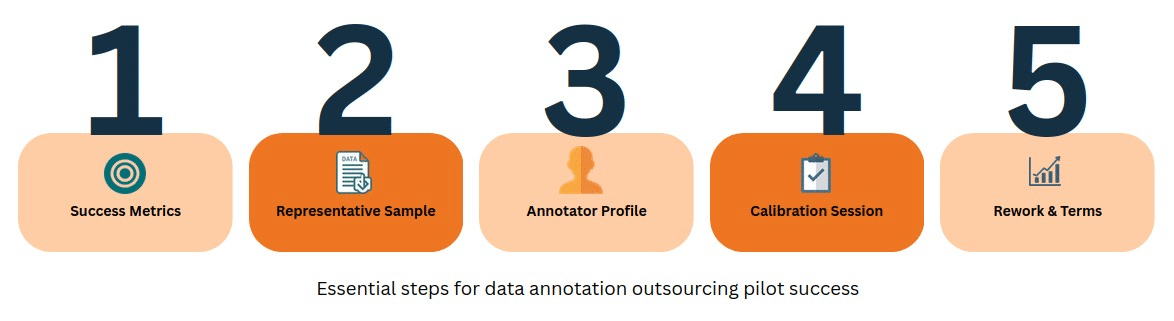
Define success metrics in writing before you start:
- IAA target appropriate to the task type
- First-pass accuracy ceiling and rework cap
- Turnaround SLA
- Contamination detection rate, where applicable
- Coverage requirement (languages, locales, domains)
Use a representative sample of your real task. If your production work involves multi-turn dialogue with clinical terminology, your pilot includes multi-turn dialogue with clinical terminology. Pilots with artificial simplicity hide the failure modes that kill production runs.
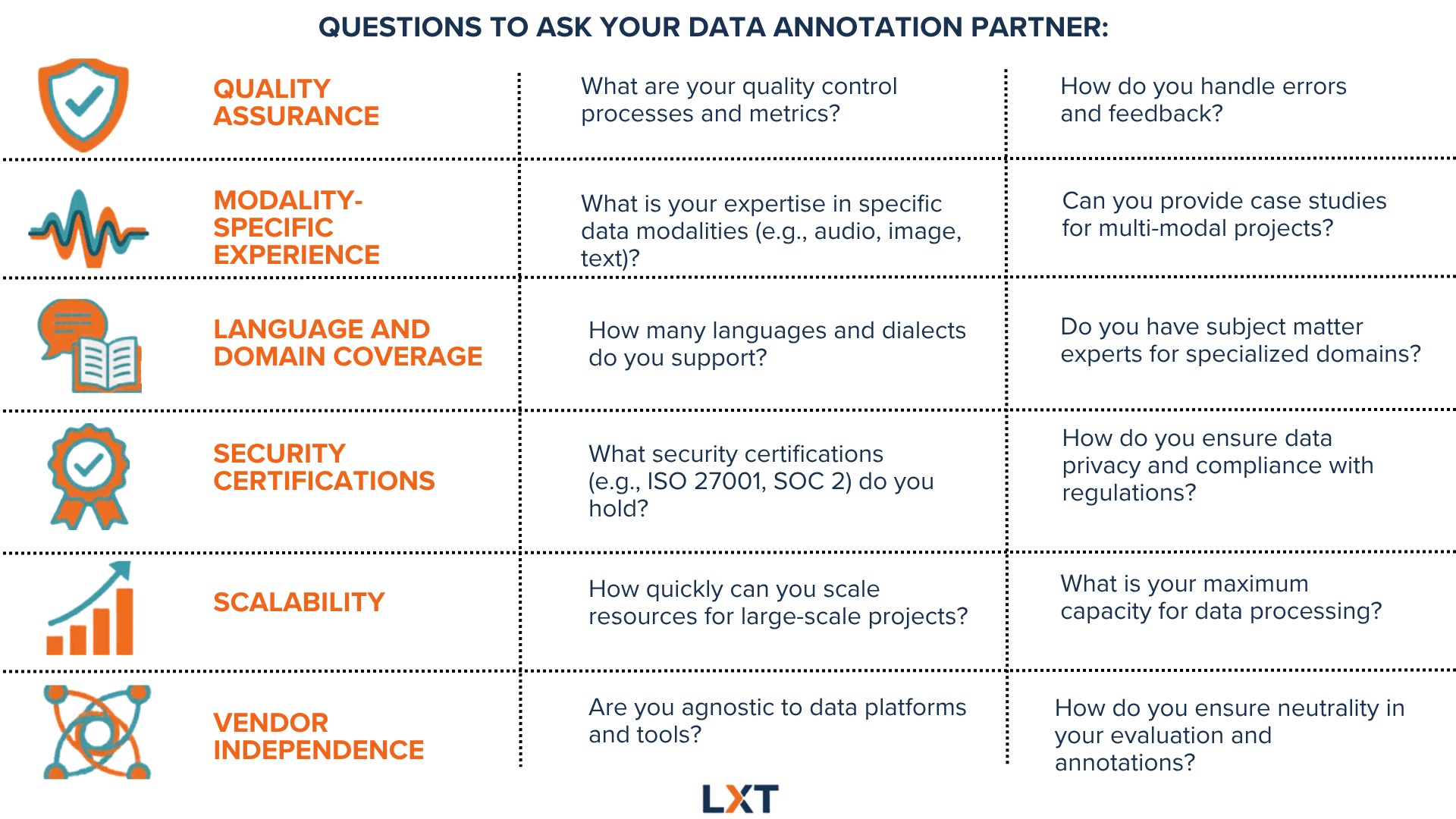
Ask for the annotator profile in detail: seniority, domain background, language profile, prior projects, training pathway. Vendors who can’t or won’t share this are not serious about your work.
Build in a calibration session after the first 50 to 100 examples. Review disagreements together, revise guidelines, re-annotate a sample to verify alignment. Early misalignment is cheap to fix. Late misalignment is full re-annotation and schedule slip.
Measure rework rate, not just first-pass accuracy. Rework is your best predictor of total program cost.
Include a termination condition. If the pilot misses success metrics, there is no obligation to continue. This keeps both sides honest about what the engagement is supposed to deliver.
How to choose
The right partner depends on what you’re actually building. A vendor strong in image classification is not automatically equipped for clinical preference data or LiDAR. A vendor with great commodity labeling capacity is not automatically a red-team partner.
Before shortlisting, get clear on:
- The mix of work you actually need across the five categories above
- Your language and domain coverage requirements
- Your quality-metric framework, by task type
- Your vendor-neutrality requirements (parent ownership, customer concentration, IP protection language)
- Your labor-diligence requirements (PAI alignment, wage floor, mental-health provisions for adversarial work)
Then run two or three pilots in parallel against the same success metrics. The right partner will agree to those metrics in writing before any long-term commitment.
LXT works across the five 2026 work categories with LLM red-teaming, RLHF preference data, supervised fine-tuning, model evaluation, and training data validation, drawing from a network of 8 million vetted contributors across 1,000+ language locales and 250,000+ domain experts. We’re vendor-neutral by design, with no parent investor competing in foundation models, and we operate ISO 27001 certified facilities with contractual protection of client taxonomies and evaluation rubrics. We’d rather lose a pilot than sell you a generic offering that doesn’t fit your work.